Lost a Receipt? What the ATO Accepts When You Lodge Your Own Tax Return
A lost receipt doesn't always mean a lost deduction. On your 2025-26 tax return you can claim some work-related expenses without receipts, within set limits, and the ATO can accept other evidence in place of a missing receipt, such as a supplier's copy or a bank statement backed by something that shows what you bought. What you can't do is claim an amount you have no way of supporting: if the ATO reviews your return and the evidence isn't there, it can remove the deduction.
Read MoreOctober 31 Tax Deadline: The Self-Lodger's Guide to Not Panicking
In short: The ATO deadline for individuals and sole traders who lodge their own tax return is 31 October, for the financial year that ended 30 June. In 2026, 31 October falls on a Saturday, so a return lodged by Monday 2 November 2026 is still on time. If you register with a registered tax agent by 31 October, you generally inherit their later lodgment program.
Read MoreDigital Receipt Management vs Paper Receipts: What the ATO Accepts
If you're still stuffing paper receipts into a shoebox, a drawer, or the glovebox of your car, you're making tax time harder than it needs to be. The ATO accepts photos and scans of receipts as records, and its guidance for businesses lists the advantages of keeping records digitally. Digital receipt management solves nearly every problem that paper receipts create. This guide explains why paper receipts are failing you, what the ATO requires from digital records, and how to make the transition without losing anything.
Read MoreVehicle and Travel Expense Deductions: The ATO's Rules Explained
In short: Under ATO rules, your regular commute is not deductible, but travel between two separate workplaces generally is. Car expenses are claimed with either the cents per kilometre method, at 88 cents for 2024-25 and 2025-26 (91 cents from 1 July 2026) on up to 5,000 business kilometres a year, or the logbook method, which applies the business-use percentage from a 12-week logbook to your actual running costs.
Read More$1,000 Flat Deduction vs Itemising: Which Wins?
In short: From FY2026-27 (income from 1 July 2026), Australian wage earners can take a flat $1,000 work-related deduction, which the ATO applies automatically, or itemise. If your documented work-related expenses exceed $1,000, itemise and claim the actual total; if they are under $1,000, or you have not kept records, take the flat $1,000. You can switch each financial year.
Read MoreATO Shadow Economy Crackdown: What the Funding Targets
In short: The ATO's shadow economy crackdown runs on Australia's 2025-26 Budget funding: $155.5 million over four years from 1 July 2025 targets under-reported income, cash-in-hand work, GST evasion, worker exploitation and illicit tobacco. Another $75.7 million, for personal income tax compliance, adds capacity to match platform and other data against returns. The 2026-27 Budget added $86.3 million for the ATO's Counter Fraud Strategy.
Read MoreAustralian Federal Budget 2026-27: Every Tax Change for Sole Traders, SMBs and Accountants
In short: Australia's 2026-27 Federal Budget (12 May 2026) brought a permanent $20,000 instant asset write-off and a $1,000 flat deduction for wage earners from 1 July 2026. From 1 July 2027, CGT indexation replaces the 50% discount and negative gearing is limited for established residential property bought after Budget night. These four are now law; the proposed 30% discretionary trust minimum tax from 1 July 2028 is not.
Read MoreCGT Reform 2027: Indexation + 30% Min on Real Gains
The most significant CGT changes 2027 budget has delivered in a generation landed on 12 May 2026 when Treasurer Jim Chalmers handed down the 2026-27 Federal Budget. The change is now law (the Treasury Laws Amendment (Tax Reform No. 1) Act 2026 received Royal Assent on 26 June 2026): from 1 July 2027, Australia's 50% CGT discount is replaced with cost base indexation paired with a 30% minimum tax on real gains, for gains arising from that date. If you hold investment property, a share portfolio, crypto, or any asset that generates a capital gain, the way your profit is taxed is set to change materially. This guide explains what was announced, who it affects, how the mechanics work, and what you can do before commencement.
Read MoreHow to Claim the New $1,000 Flat Tax Deduction (Step-by-Step)
Here is how to claim the $1,000 flat deduction announced in the Australian Federal Budget on 12 May 2026: confirm you're eligible, total your actual work-related expenses, decide whether the flat claim or itemising gives you a bigger number, then lodge your FY2026-27 tax return accordingly. That is the first year this deduction applies, covering income from 1 July 2026. This guide walks through each of those steps in plain language, with worked examples and answers to the questions that trip people up.
Read MoreIAWO Recordkeeping Checklist Now It's Permanent
In short: Each claim under Australia's permanent $20,000 instant asset write-off needs seven records: the tax invoice, proof of payment, the asset description and serial number, the first-use or installation date, a business-use percentage for mixed-use assets, an asset register entry and any simplified depreciation election. The ATO says to keep them while you hold the asset and for five years after you dispose of it.
Read MoreLoss Carry-Back Records Your Clients Need to Keep
In short: From 1 July 2026, Australian companies with aggregated turnover under $1 billion can carry a tax loss back against tax paid in up to two prior income years. Each claim needs five records: the prior-year notices of assessment, a reconciled loss calculation, receipts for major loss-year deductions, a franking account statement and a director-signed narrative of the loss drivers.
Read MoreLoss Carry-Back Returns: Refundable Losses for SMB
The 2026-27 Federal Budget, handed down on 12 May 2026, restores loss carry back for small and medium businesses, giving eligible companies the ability to convert a current-year tax loss into a real cash refund against income tax paid in the previous two financial years. If your company is heading into a loss year after several profitable ones, this measure could put money back in your account rather than leaving it stranded as a carried-forward deduction.
Read MoreMedicare Levy Thresholds Increased 2.9% for 2026
The Medicare levy threshold 2026 increased by 2.9% in the Federal Budget delivered on 12 May 2026, extending relief to approximately 1 million low-income Australians who would otherwise pay the full 2% levy on their income. The change is modest in dollar terms for any single taxpayer, but it keeps low-income individuals and families exempt from the levy as their incomes rise.
Read MoreNegative Gearing Limits 2027: What Investors Lose
The negative gearing changes announced in the 2026 Budget are the most significant restriction on residential property investment in Australia's recent tax history, and they are now law. Announced in the 2026-27 Federal Budget on 12 May 2026 and enacted in June 2026, the change means that from 1 July 2027, investors who purchase established residential property after 7:30pm AEST on Budget night will no longer be able to offset rental losses against their salary or business income. The cut-off is clear: existing property holders are grandfathered indefinitely, new builds remain fully exempt, and the change affects only established dwellings acquired from that point forward. It was arguably the most politically contested element of the entire Budget package.
Read MorePayday Super Starts 1 July 2026: What to Know
In short: Payday super, which became law in 2025, started on 1 July 2026: Australian employers must now pay super with each pay run instead of quarterly, and it must reach the employee's fund within 7 business days of the pay date. Sole traders without employees are not affected, and the 12% super guarantee rate is unchanged.
Read MorePayday Super: Accountant Readiness Checklist for 1 July 2026
In short: Payday Super has applied since 1 July 2026: Australian employers must pay super with each wage payment, and it must reach the employee's fund within 7 business days. Accountants should work out which clients are in scope, audit payroll and STP Phase 2 readiness, test the clearing house pathway, model the cash flow change and check that the first pay cycles reached funds on time.
Read MorePermanent $20,000 Instant Asset Write-Off Explained
The permanent instant asset write-off 2026 is now law. The Australian Government announced in its 2026-27 Federal Budget, delivered on 12 May 2026, that the $20,000 instant asset write-off (IAWO) would be made permanent from 1 July 2026, and Parliament has since passed it in the Treasury Laws Amendment (Tax Reform No. 2) Act 2026 (assented to on 26 August 2026). That ends the annual cycle of extensions and sunset clauses that has made planning difficult for small businesses since the scheme was expanded during COVID. If you've been using the IAWO for years without thinking much about it, not much will change day-to-day. But if you've ever delayed an equipment purchase because you weren't sure whether the scheme would still exist next financial year, that uncertainty is now gone.
Read MoreThe New $1,000 Flat Tax Deduction: Who Qualifies
In short: Australia's $1,000 flat deduction for work-related expenses applies from the 2026-27 income year (from 1 July 2026), needs no receipts and has been law since June 2026. It goes to Australian residents for tax purposes who earn assessable labour income, such as salary and wages, director fees or parental leave pay. Sole traders who only earn business income aren't eligible.
Read MoreTrust 30% Minimum Tax Coming in 2028
The discretionary trust tax changes 2028 are now officially on the table: on 12 May 2026, the Federal Government handed down the 2026-27 Budget and announced a 30% minimum tax on the taxable income of discretionary trusts, proposed to start on 1 July 2028. It is not yet law, but if passed it would be the most significant structural change to family trust taxation in a generation. Around 350,000 small businesses across Australia operate through a discretionary trust.
Read MoreTrust Restructure Window: How to Advise Clients
In short: As proposed in Australia's 2026-27 Federal Budget, subject to legislation, discretionary trusts would get rollover relief to restructure into another entity, such as a company or fixed trust, from 1 July 2027 to 30 June 2030, ahead of a proposed 30% minimum tax from 1 July 2028. Triage trust clients into four buckets, model stay versus restructure, document the decision and wait for the final legislation before executing.
Read MoreWorking Australians Tax Offset: $250 Explained
The working Australians tax offset 2026 is official: the Federal Budget, delivered 12 May 2026, announced a permanent new Working Australians Tax Offset (WATO) of up to $250, starting from 1 July 2027. More than 13 million workers will benefit automatically, with no separate claim required. Here is what the measure does, who it covers, and how it layers on top of the other tax changes already flowing through from 1 July 2026.
Read More17 Tax Deductions Australian Freelancers Miss Every Year
In short: The ATO lets Australian freelancers deduct expenses directly related to earning their income, provided they have records to prove it. This list of 17 commonly missed deductions covers larger items such as home office running costs, travel between work locations, equipment depreciation and income protection insurance, plus small costs that add up, including software subscriptions, professional memberships and bank fees.
Read MoreThe Complete Guide to Scanning and Storing Receipts for Tax Compliance
In short: The ATO accepts a clear, legible photo or scan of a receipt, so you don't need to keep the paper. Store the digital copies securely with a backup and keep them for five years from the date you lodge your tax return. Scan each receipt as soon as you get it, flat and in good light, and check that the date, amount and vendor are readable.
Read MoreThe Best ATO myDeductions Alternative for 2026
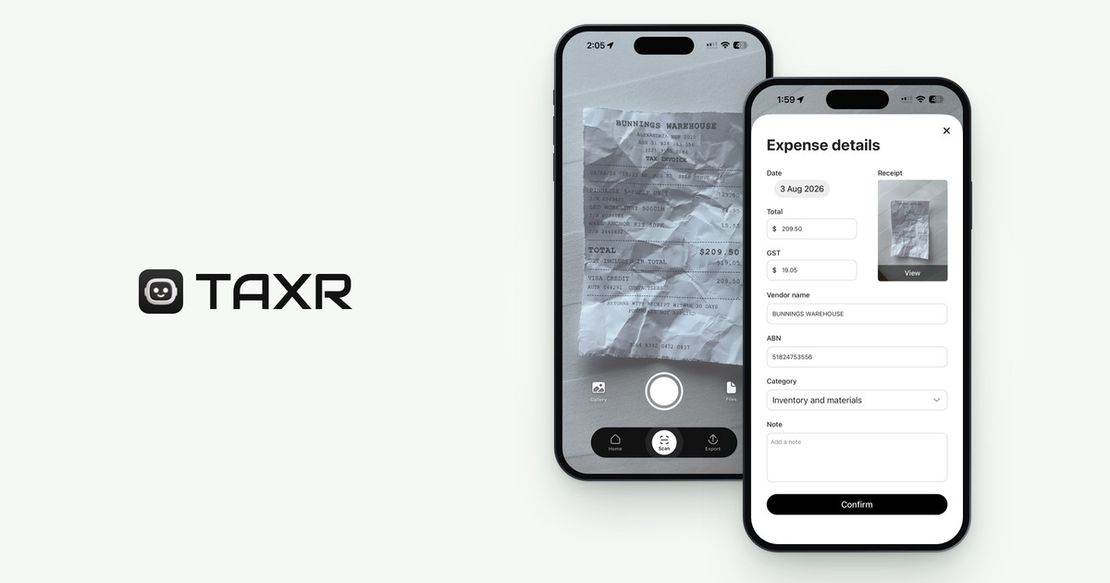
In short: For Australian freelancers and sole traders who have outgrown myDeductions in the ATO app, an AI receipt scanner such as Taxr is the better choice: it reads the date, amount, vendor and GST from each receipt, stores records in the cloud and exports Excel or PDF reports. myDeductions is free and feeds into myTax, but you type in every expense by hand and run backups yourself.
Read More