Business Finance
- Home /
- Categories /
- Business Finance
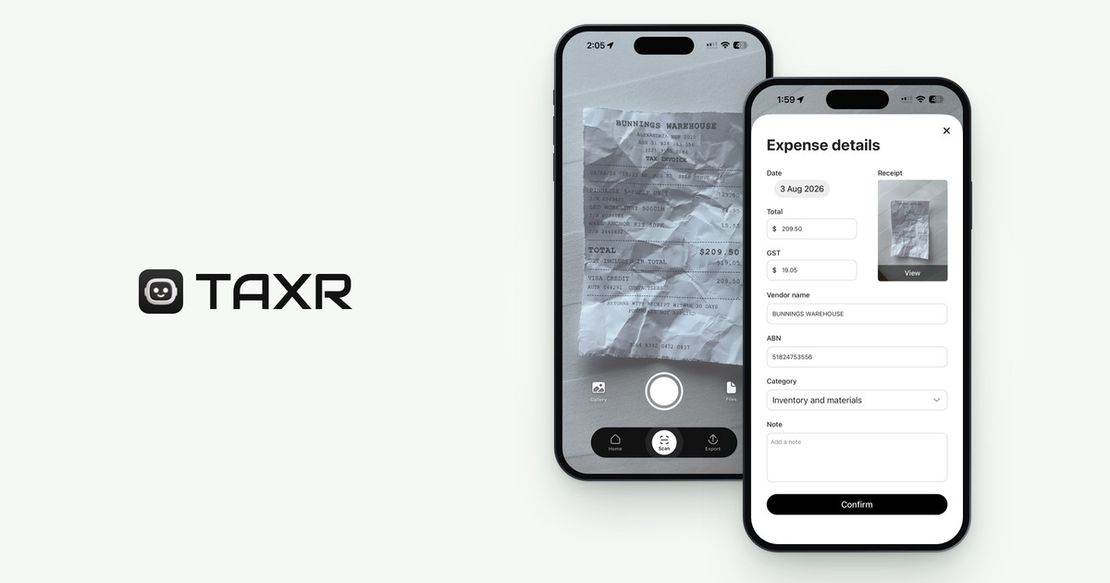
Tax Planning for the New Year: Start 2027 with Better Expense Habits
In short: Start 2027 by reviewing which deductions you missed last year, setting up categories that match your tax return, scanning every receipt as soon as you get it, spending 10 minutes a week on your records and setting aside around 30% of every payment for tax. Australian freelancers, whose financial year runs from 1 July to 30 June, should also schedule a mid-year check-in in January.
Read More5 Cash Flow Mistakes Small Businesses Make (and How to Fix Them)
In short: The five cash flow mistakes are mixing business and personal money, spending as if busy months will last, not saving for tax, paying bills late and not tracking expenses. For Australian freelancers and sole traders, the fixes are a separate business account, a buffer of at least three months of essential expenses, 30% of every payment set aside for tax, bills paid on time and real-time tracking.
Read More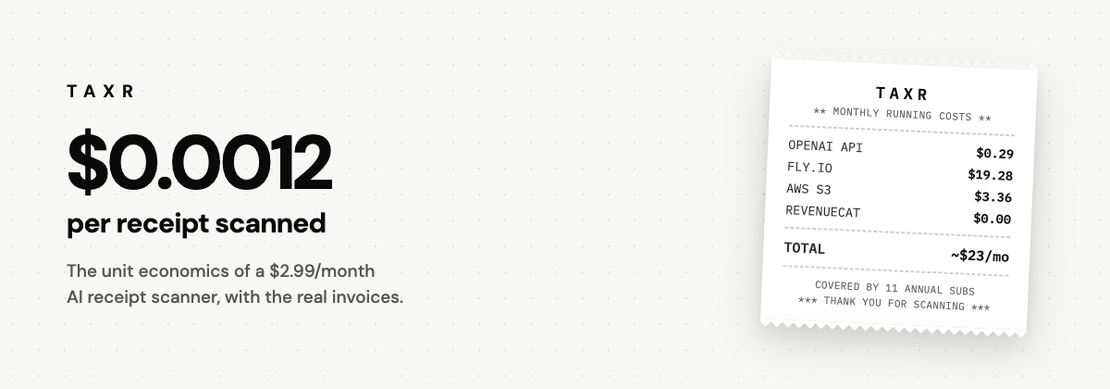
The Unit Economics of a $2.99/Month AI Receipt Scanner
In short: Each Taxr receipt scan costs about $0.0012 in AI inference, a tenth of a cent, and the whole product runs on about $23 a month for inference, hosting and storage. After the 15% store commission, an annual App Store subscriber is worth about $25.49 a year, so eleven annual subscriptions cover the running costs, though development time is the real investment.
Read MoreGST for Small Business: When to Register and How to Track It
In short: The ATO requires you to register for GST if your business has a GST turnover of $75,000 or more in the current or previous 12 months, or expects to reach $75,000 in the coming 12 months. Taxi and rideshare drivers must register regardless of turnover. Once registered, record the GST on every transaction, keep your tax invoices for five years and reconcile before each BAS.
Read MoreCGT Reform 2027: Indexation + 30% Min on Real Gains
The most significant CGT changes 2027 budget has delivered in a generation landed on 12 May 2026 when Treasurer Jim Chalmers handed down the 2026-27 Federal Budget. The change is now law (the Treasury Laws Amendment (Tax Reform No. 1) Act 2026 received Royal Assent on 26 June 2026): from 1 July 2027, Australia's 50% CGT discount is replaced with cost base indexation paired with a 30% minimum tax on real gains, for gains arising from that date. If you hold investment property, a share portfolio, crypto, or any asset that generates a capital gain, the way your profit is taxed is set to change materially. This guide explains what was announced, who it affects, how the mechanics work, and what you can do before commencement.
Read MoreLoss Carry-Back Returns: Refundable Losses for SMB
The 2026-27 Federal Budget, handed down on 12 May 2026, restores loss carry back for small and medium businesses, giving eligible companies the ability to convert a current-year tax loss into a real cash refund against income tax paid in the previous two financial years. If your company is heading into a loss year after several profitable ones, this measure could put money back in your account rather than leaving it stranded as a carried-forward deduction.
Read MoreNegative Gearing Limits 2027: What Investors Lose
The negative gearing changes announced in the 2026 Budget are the most significant restriction on residential property investment in Australia's recent tax history, and they are now law. Announced in the 2026-27 Federal Budget on 12 May 2026 and enacted in June 2026, the change means that from 1 July 2027, investors who purchase established residential property after 7:30pm AEST on Budget night will no longer be able to offset rental losses against their salary or business income. The cut-off is clear: existing property holders are grandfathered indefinitely, new builds remain fully exempt, and the change affects only established dwellings acquired from that point forward. It was arguably the most politically contested element of the entire Budget package.
Read MoreTrust 30% Minimum Tax Coming in 2028
The discretionary trust tax changes 2028 are now officially on the table: on 12 May 2026, the Federal Government handed down the 2026-27 Budget and announced a 30% minimum tax on the taxable income of discretionary trusts, proposed to start on 1 July 2028. It is not yet law, but if passed it would be the most significant structural change to family trust taxation in a generation. Around 350,000 small businesses across Australia operate through a discretionary trust.
Read MoreSole Trader vs Company in Australia: Which Structure Is Right for You?
In short: For many freelancers starting out in Australia, a sole trader structure is the obvious choice because it is simpler and cheaper to run. A company gives limited liability and a flat 25% tax rate for base rate entities, but costs more in fees and compliance. It is worth considering when taxable business income is regularly above $135,000 and you don't need to withdraw all of it.
Read MoreFreelancer Expense Categories Explained: A Simple Breakdown
In short: The categories most Australian freelancers use regularly are office supplies and equipment, software and subscriptions, travel and transport, home office, professional development, marketing and advertising, insurance, communication (phone and internet) and professional services. When an expense fits more than one, pick the most specific category and use it consistently, and claim only the work-related portion of anything you also use personally.
Read More