Vehicle and Travel Expense Deductions: The ATO's Rules Explained
Table of Contents
In short: Under ATO rules, your regular commute is not deductible, but travel between two separate workplaces generally is. Car expenses are claimed with either the cents per kilometre method, at 88 cents for 2024-25 and 2025-26 (91 cents from 1 July 2026) on up to 5,000 business kilometres a year, or the logbook method, which applies the business-use percentage from a 12-week logbook to your actual running costs.
Vehicle and travel expenses are some of the most commonly claimed deductions in Australia, and some of the most commonly disallowed. The ATO scrutinises car claims closely, and getting the rules wrong can mean lost deductions, amended returns, or penalties. If you drive to client sites, travel between workplaces, or carry heavy tools in your ute, understanding the ATO's rules for vehicle and travel expense deductions is essential to claiming what you're entitled to, and nothing more.
Disclaimer: This article provides general information only and does not constitute tax advice. Consult a registered tax agent for advice specific to your circumstances.
What Counts as Work-Related Travel
The first and most important rule: your regular commute from home to your normal workplace is not deductible. The ATO considers this private travel, regardless of how far you drive or how much it costs. This is the rule that catches more taxpayers than any other.
However, many types of travel beyond the daily commute are deductible. You can generally claim travel that is:
- Between two separate workplaces: for example, driving from your main office to a client's premises, or from one job site to another
- From your home to an alternative workplace: if you have a regular workplace but are required to travel directly to a different location for a specific task
- To and from your home if your home is your base of operations: sole traders who genuinely work from a home office and travel to clients can claim the travel from home to the client and back
- When carrying bulky tools or equipment: if you need to transport tools or equipment to work and there is no secure storage available at your workplace, the travel from home to work may be deductible
- Interstate or regional travel for work: flights, accommodation, and meals for work trips away from your usual location
The key test the ATO applies is whether the travel is incidental to your work duties, not just travel to the place where your work happens. For full details, see the ATO's guide to motor vehicle expenses.
Cents Per Kilometre Method
The cents per kilometre method is the simpler of the two options for claiming car expenses. Under this method:
- You claim a flat rate of 88 cents per kilometre for the 2024-25 and 2025-26 financial years (the rate rises to 91 cents from 1 July 2026)
- The maximum claim is 5,000 business kilometres per year
- The rate covers all vehicle running costs: fuel, registration, insurance, depreciation, maintenance, and servicing. You cannot claim these separately on top of the per-kilometre rate.
- You do not need written evidence of each kilometre driven, but the ATO requires that your claim is based on a reasonable estimate. You should be able to explain how you calculated your business kilometres if asked.
The maximum claim under this method is 5,000 km x $0.88 = $4,400 per year for 2025-26 (5,000 km x $0.91 = $4,550 for 2026-27). To work out the claim for your own kilometres, use our cents per km calculator.
When cents per km makes sense
This method works well if you:
- Drive relatively few business kilometres (under 5,000 per year)
- Want a simple, low-administration approach
- Have a newer or fuel-efficient vehicle with low running costs (so the flat rate covers your actual costs or more)
- Don't want to keep a logbook
Calculating your business kilometres
Even though you don't need a logbook, you still need a reasonable basis for your claim. Common approaches include recording your odometer readings at the start and end of the financial year, keeping a diary of regular business trips, or using a mapping app to calculate typical route distances. The ATO uses data analytics to identify claims that are unusually high for a particular occupation, so make sure your estimate is supportable.
Logbook Method
The logbook method is more work to set up, but it typically results in a larger deduction for people who drive significant business kilometres. Under this method:
- You keep a logbook for a continuous 12-week period that is representative of your normal driving patterns
- The logbook records each business trip during that period (the date, start and end odometer readings, kilometres driven and the purpose of the trip), plus the odometer readings at the start and end of the 12 weeks. Private trips don't need their own entries, because they show up in the total kilometres
- At the end of the 12-week period, you calculate your business-use percentage, the proportion of total kilometres that were for business
- You then apply that percentage to your actual vehicle running costs for the full year to calculate your deduction
- The logbook is valid for five years, provided your circumstances don't change significantly
What you can claim under the logbook method
Under the logbook method, you claim your business-use percentage of the following actual costs:
- Fuel and oil
- Registration
- Insurance
- Repairs and maintenance (servicing, tyres, mechanical repairs)
- Depreciation (the decline in value of the vehicle)
- Finance charges (interest on a car loan, but not the principal)
Tolls and parking aren't part of this calculation. You claim the tolls and parking fees you pay on work trips separately, as travel expenses. Tolls on your commute and parking at or near your regular workplace can't be claimed at all.
For example, if your logbook shows a 70% business-use percentage and your total running costs for the year are $12,000, your deduction would be $12,000 x 70% = $8,400.
Record-keeping requirements
The logbook method requires you to keep:
- The completed 12-week logbook
- Odometer readings at the start and end of each financial year
- Receipts for all vehicle running costs (fuel, servicing, registration, insurance, repairs)
- Records showing how you calculated the depreciation of your vehicle
This is where many claims fall apart. If the ATO audits you and you can't produce the logbook or the receipts to support your actual costs, the deduction is disallowed.
Which Method Is Better?
For most sole traders and self-employed workers who drive regularly for business, the logbook method produces a larger deduction. This is especially true if:
- You drive more than 5,000 business kilometres per year (which is common for tradies, rideshare drivers, sales reps, and mobile service providers)
- Your vehicle has high running costs (older vehicles, utes, vans)
- Your business-use percentage is high
The cents per kilometre method is capped at $4,400 for 2025-26, regardless of how much you actually spend on your vehicle. If your actual costs are $15,000 and your business-use percentage is 60%, the logbook method gives you $9,000, more than double that cap.
That said, the cents per kilometre method wins on simplicity. If your business kilometres are low and you don't want to keep a logbook, it's a perfectly valid choice.
You can only use one method per vehicle per year. If you have two vehicles, you can use a different method for each.
Other Travel Expenses You Can Claim
Beyond car expenses, the ATO allows deductions for other work-related travel costs:
- Public transport fares: trains, buses, trams, ferries, and ride-share services used for work travel (not commuting)
- Tolls: when travelling for work purposes
- Parking: at a work location that isn't your regular workplace (not your home, and not your regular office car park)
- Accommodation: when you need to stay overnight for work
- Meals: when you travel overnight for work and are away from your home for at least one night
For overnight travel, you claim what you actually spend. If your employer pays you a travel allowance and your claim is no more than the ATO's reasonable amount, you don't need receipts, but you still need to show that you spent the money on the work trip, how you worked out your claim, and that you declared the allowance as income.
Record-Keeping Tips
Regardless of which method you choose, the ATO expects you to have records:
- Scan fuel and vehicle receipts immediately: thermal receipts fade fast. Scan them the day you get them.
- Keep a digital copy of your logbook: photograph each page and store it digitally in case the paper version is lost.
- Record your odometer at the start of each financial year: take a photo on 1 July and 30 June as proof of total kilometres driven.
- Track tolls and parking: these small amounts are easy to forget but add up over a year.
For rideshare drivers, our guide to tax deductions for rideshare drivers covers platform-specific rules. And for tradies, see our post on tax deductions for tradies and sole traders. Note: the 2026-27 Federal Budget announced that from 1 July 2027, negative gearing will be limited to new builds, and established homes bought after 7:30pm AEST on 12 May 2026 won't be able to offset their losses against wages. If you drive to a residential rental property you own, note that the travel itself generally isn't deductible: since 1 July 2017, individual investors can't claim travel to inspect, maintain or collect rent from a residential rental property unless they're in the business of letting properties. For the Budget's property changes, read the negative gearing changes guide.
Track Your Vehicle Expenses with Taxr
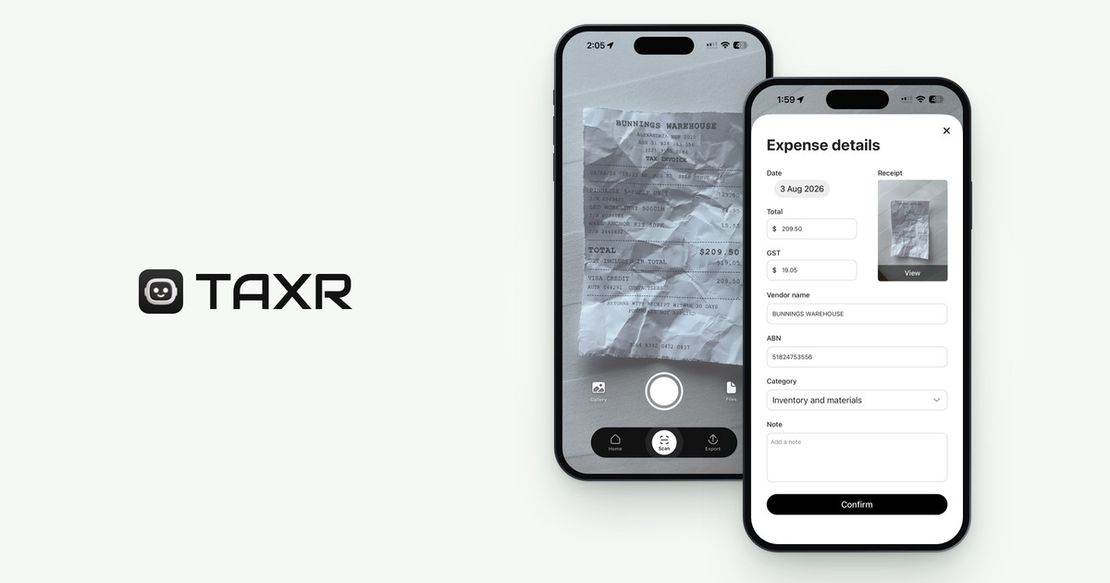
Keeping accurate vehicle expense records is the difference between a solid deduction and a disallowed claim. Taxr makes it simple: scan your fuel receipts, toll receipts, service invoices, and parking tickets as you go. The AI reads the details and suggests a category for each expense, which you confirm. When it's time to lodge your return or meet with your accountant, export an Excel or PDF report showing your total vehicle costs with GST breakdowns, ready to apply your logbook percentage.
Stop losing receipts and leaving deductions on the table. Download Taxr and start tracking your vehicle expenses today.