UK Sole Trader Allowable Expenses: A Guide for 2026-27
Table of Contents
In short: For 2026-27, HMRC lets UK sole traders deduct a cost from their income if it was incurred wholly and exclusively for the business, and mixed-use costs are apportioned to the business share. The main allowable categories are office costs, travel, vehicle costs, staff costs, stock and materials, and use of home; client entertainment, everyday clothing and commuting are not allowable.
If you're a UK sole trader, working out which costs count as allowable expenses is one of the most valuable things you can get right: every pound of a genuine business cost you claim is a pound that doesn't get taxed as profit. It's also an area where people go wrong in both directions, under-claiming out of caution or over-claiming out of guesswork, and the second risks an HMRC enquiry. This guide covers the main categories of allowable expenses, what falls outside them, the principle HMRC applies to every claim, and why good records matter more than ever now that Making Tax Digital is rolling out. Where a specific rate or threshold is involved, we'll point you to gov.uk rather than guess.
Disclaimer: This article provides general information only and does not constitute tax advice. Consult a qualified accountant or tax adviser about your circumstances.
The "wholly and exclusively" test
Every allowable expense claim comes back to one HMRC test: was the cost incurred wholly and exclusively for the purposes of your trade? If the answer is a clean yes, you can normally deduct it from your income before working out your taxable profit. If the answer is "partly," the claim doesn't automatically fail. It gets apportioned instead.
Apportionment is how HMRC handles the real world, where plenty of costs serve both your business and your personal life: a mobile phone used for client calls and for texting friends, a car driven to job sites and to the supermarket, a spare room that's an office by day and a guest room at weekends. The usual approach is a fair, reasonable split (by time, usage, or floor area, whatever fits the cost), claiming only the business proportion.
What doesn't survive the test is a cost that's genuinely personal with a business excuse attached. HMRC's recurring question is simple: would you have incurred this cost anyway, for reasons that have nothing to do with the business? If yes, and the business element can't be separated out, it's unlikely to be allowable.
Allowable expenses: the main categories
HMRC groups allowable expenses into broad categories that map onto the boxes on your Self Assessment return and, if you're mandated into Making Tax Digital, your quarterly update categories too:
- Office costs: stationery, the business share of phone and internet bills, software subscriptions, printing, and postage. In other words, the everyday admin of running a business.
- Travel: business mileage, train and bus fares, parking, tolls, and reasonable subsistence (food and drink) while travelling for work. This covers trips to clients, suppliers, or temporary workplaces, but not your regular commute (more below).
- Vehicle costs: if you use a vehicle for business, you can claim a proportion of the actual running costs (fuel, insurance, servicing, repairs) based on business use, or use HMRC's simplified flat-rate mileage scheme instead of tracking every receipt. Our simplified expenses guide covers choosing between the two, and where to find current rates. If you drive for Uber or Deliveroo, our guide to Uber and Deliveroo driver taxes in the UK covers the running costs drivers typically track.
- Clothing and uniform: protective clothing (hi-vis, steel-toe boots, overalls) and branded uniform are allowable. Everyday clothing isn't, even if you only ever wear it for work. A suit or plain black t-shirt fails the test because you could wear it outside your trade too.
- Staff costs: salaries and wages, subcontractor payments, employer National Insurance contributions, and employer pension contributions.
- Stock and materials: goods you buy for resale and raw materials you use to make what you sell.
- Legal and financial: accountancy and legal fees related to the business, bank charges on a business account, and business insurance.
- Marketing: website costs, advertising, and directory listings.
- Training: courses that maintain or update skills you already use in your trade are generally allowable. Training for a brand-new trade or skillset is where HMRC usually draws the line, since that builds a new capability rather than maintaining one you already have, so it's typically not allowable.
- Use of home: if you work from home, you can claim a proportion of household costs (heating, electricity, council tax, and similar) based on business use, or use HMRC's simplified flat rate based on hours worked from home each month. It's the same trade-off as vehicle costs, and the simplified expenses guide covers both flat rates.
For the current mileage rates, home-working flat rates, and the full official list of allowable expenses, HMRC's own guide is the definitive source: gov.uk/expenses-if-youre-self-employed.
What's not allowable
What you can't claim matters just as much. HMRC disallows:
- Client entertainment: meals, drinks, tickets, or gifts for clients or prospects, even when the purpose is clearly business development.
- Everyday clothing: ordinary clothes don't become a business expense just because you wear them to work.
- Commuting: travel between your home and a regular, permanent workplace is a personal cost in HMRC's eyes, not a business one, no matter how far the journey is.
- Purely personal expenses: anything with no business purpose at all, even if it happened while you were "on the job" in a loose sense.
- Fines and penalties: parking tickets, speeding fines, and similar penalties aren't deductible, even if incurred on a business trip.
- The private-use portion of any mixed-use cost: the flip side of apportionment above. Whatever slice of a mixed cost is personal use stays outside your claim.
Why this matters even more under MTD
Getting your categories right used to matter once a year, at Self Assessment time. Under Making Tax Digital, it matters four times a year. Mandated quarterly updates report cumulative totals per income and expense category (HMRC doesn't see your individual receipts, only the category totals), so you need to know, in real time, whether a cost is office costs or legal and financial, and whether it's allowable in full or needs apportioning.
Reconstructing nine months of receipts from memory in January was never a great system; doing it every quarter is worse. The fix is capturing and categorising expenses as they happen, not batching the work later. Our guide to what counts as digital records under MTD covers what HMRC expects day-to-day, and the full MTD guide covers the rest of the rollout.
Keeping records for your claims
Whatever the category, the record-keeping principle is the same: for every allowable expense, keep evidence of the date, the amount, what it was for (the category), and who you paid (the supplier or vendor). A bank statement line won't do it. HMRC can ask you to justify a claim, and "I remember buying something from that shop" isn't a record.
Digital copies count. A photo of a receipt is a legal record as long as the original details stay legible, which is one reason paper receipts that fade, get lost, or pile up in a glovebox are a liability rather than an asset. Keep records for as long as HMRC requires (check gov.uk for the current retention period), and file them by category as you go, not all at once later.
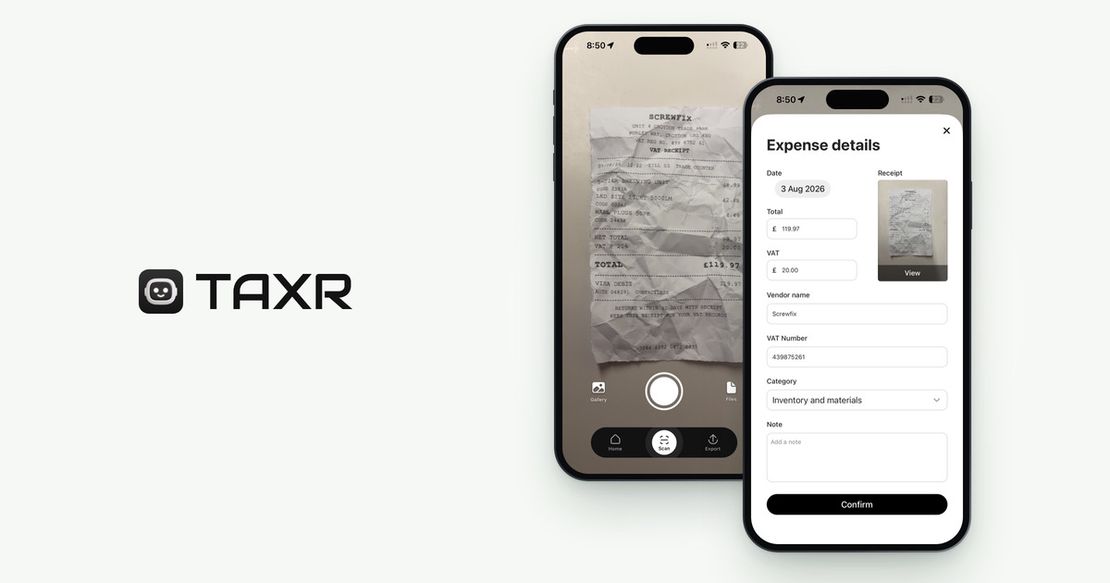
Download Taxr free and capture every allowable expense as it happens
The best time to record an allowable expense is the moment you incur it, receipt still in hand and the reason for the purchase still fresh. Taxr's AI receipt scanner does most of the categorising for you: photograph a receipt and it pulls out the vendor, date, total, and VAT, then suggests a tax-aligned category for you to confirm. Export Excel or PDF records to hand to your accountant, so nothing gets forgotten by January, or by your next quarterly update. If you file through your own MTD software, check whether it can import the Excel file.