Tax Deductions Every Tradie Should Know in Australia
Table of Contents
In short: Tradies in Australia can claim tools and equipment, vehicle travel between job sites, protective and occupation-specific workwear, and insurance premiums. Sole traders with an aggregated turnover under $10 million can use the instant asset write-off for assets under the $20,000 limit, while the $300 immediate deduction is for employees. Plain clothes aren't deductible, even if they get ruined on the job.
If you're a sparkie, chippie, plumber, or painter, you're probably spending thousands of dollars a year on tools, fuel, workwear, and insurance, all of which can reduce your tax bill. Tax deductions for tradies in Australia are generous, but only if you know what you're entitled to and keep the receipts to back it up. This guide covers every major deduction category so you can keep more of what you earn.
Disclaimer: This article provides general information only and does not constitute tax advice. Consult a registered tax agent for advice specific to your circumstances.
Tools and Equipment Deductions
Tools are the backbone of any trade, and the ATO recognises that. How you claim them depends on what they cost, and the rules differ for employees and sole traders:
- Items costing $300 or less: if you're an employee and use the tool mainly for your job, claim an immediate deduction in full in the year of purchase. This covers most hand tools: tape measures, screwdrivers, chisels, utility knives, spirit levels, and similar items. The $300 rule doesn't apply to tools you use in your own business.
- Items costing more than $300: as an employee, depreciate the cost over the item's effective life.
- Instant asset write-off: if you're a sole trader with an aggregated turnover under $10 million and you use the simplified depreciation rules, you can claim the business portion of each tool costing less than $20,000 in full in the year you first use it, from a screwdriver to a $1,200 power drill. More on this below.
Common tool and equipment deductions for tradies include:
- Hand tools (hammers, wrenches, pliers, screwdrivers, saws)
- Power tools (drills, circular saws, angle grinders, impact drivers, nail guns)
- Measuring and testing equipment (laser levels, multimeters, moisture meters)
- Tool storage (toolboxes, work belts, bags, and cases)
- Safety equipment (harnesses, respirators, hearing protection, safety glasses)
- Ladders and scaffolding
Keep every receipt, even for small items. A tradie spending $50 a month on replacement hand tools, drill bits, and blades is looking at $600 a year in deductions, but only if there's proof.
Vehicle and Travel Expenses for Tradies
Most tradies travel between job sites daily, and vehicle expenses are often the single biggest deduction available. The ATO offers two methods:
Cents per Kilometre Method
- 88 cents per business kilometre (the rate for 2024-25 and 2025-26; 91 cents from 1 July 2026)
- Capped at 5,000 km per year
- Maximum claim of $4,400 ($4,550 for 2026-27)
- Simple, but usually too low for tradies who drive to multiple sites daily
Logbook Method
- Keep a logbook for a minimum of 12 consecutive weeks
- Calculate your business-use percentage
- Claim that percentage of all running costs: fuel, rego, insurance, servicing, repairs, tyres, loan interest, and depreciation
For tradies running a ute or van, the logbook method almost always comes out ahead. A tradie with a $55,000 ute, 35,000 km per year, and a 75% business-use percentage could be looking at well over $10,000 in vehicle deductions. To see what the cents per km method would give you instead, try our cents per km calculator.
Important: The ATO generally treats travel from home to a regular workplace as a non-deductible commute. However, there are two key exceptions for tradies:
- Travel between job sites during the day is fully deductible.
- Carrying bulky tools can make your trip between home and work deductible, but only if all of these apply: the tools are essential to your work, they're bulky (awkward to transport because of their size and weight, so a vehicle is the only practical way to move them), there's no secure storage for them at the workplace, and you're not carrying them by choice. Taking your toolkit home when you could lock it up on site doesn't count, and you'll need records of what you carry, its size and weight, and the lack of secure storage. The ATO has specific guidance on this, and it's worth reading if you carry your tools in your vehicle.
Workwear and Protective Clothing
You can claim work-related clothing and laundry expenses, but only if the clothing falls into one of these categories:
- Protective clothing: items that protect you from injury or illness on the job
- Occupation-specific clothing: items that are specific to your trade and not suitable for everyday wear
- Compulsory uniforms: clothing your employer requires you to wear (a non-compulsory uniform only counts if its design is registered with AusIndustry)
Deductible workwear for tradies typically includes:
- Hi-vis shirts, vests, and jackets
- Steel-cap boots and safety footwear
- Hard hats and bump caps
- Sun-protection hats with a wide brim (if required for outdoor work)
- Heavy-duty work trousers with reinforced knees
- Wet-weather gear
- Gloves (welding, electrical, general work)
- Safety glasses and goggles
- Sunscreen (if you work outdoors, since it's classed as sun protection)
What you can't claim: Plain clothes, even if you only wear them for work. A pair of regular jeans or a plain t-shirt is not deductible, even if they get ruined on the job. The clothing has to be occupation-specific or protective in nature.
You can also claim laundry costs for eligible work clothing. Up to the 2025-26 income year, if your total laundry claim is under $150, you don't need written evidence: you can use a reasonable estimate. Above $150, you'll need a diary of laundry loads and costs. From 1 July 2026 the $150 exception ends, so keep a laundry diary for any laundry you claim.
Insurance Premiums You Can Claim
Insurance is a significant cost for tradies and sole traders, and most premiums are fully deductible:
- Public liability insurance: essential for any tradie working on client property
- Professional indemnity insurance: protects against claims of negligent advice or work
- Income protection insurance: premiums are deductible (but note: if you claim through the policy, the payment is assessable income)
- Tool and equipment insurance: covers theft, damage, or loss of your tools
- Workers' compensation insurance: if you employ staff, this premium is deductible
- Commercial vehicle insurance: the work-use percentage of your ute or van insurance
A sole trader paying $1,500 for public liability, $800 for income protection, and $400 for tool insurance is looking at $2,700 in deductible insurance costs per year. Don't forget to keep the invoices or premium notices, because they're your proof.
The Instant Asset Write-Off
The instant asset write-off is one of the most valuable concessions for tradies and sole traders. It allows eligible small businesses to immediately deduct the cost of an asset, rather than depreciating it over several years.
Key points:
- Eligibility: you must be a small business with an aggregated annual turnover of less than $10 million
- Threshold: the limit is $20,000 per asset, which has applied since 1 July 2023. Check the ATO's instant asset write-off page for the current rules
- What qualifies: most business assets that cost less than the limit, including tools, equipment, and vehicles. An asset that costs more goes into the small business pool instead, and for passenger vehicles the amount you can depreciate is capped at the car limit ($69,674 for 2025-26 and $69,883 for 2026-27)
- Used assets count: the asset doesn't have to be brand new
This concession is particularly useful for tradies making big-ticket purchases under the $20,000 limit: a trailer, a welder, a compressor, or an air conditioning unit for installations. Instead of spreading the deduction over several years, you get the full benefit in the year of purchase. The 2026-27 Federal Budget made this concession permanent. Read the full 2026 Budget impact guide for tradies and sole traders for the details.
Example: A plumber buys a $6,000 pipe-locating camera. Under normal depreciation, they might claim $1,200 per year over five years. With the instant asset write-off, they claim the full $6,000 in one hit.
Digital Record-Keeping for Tradies
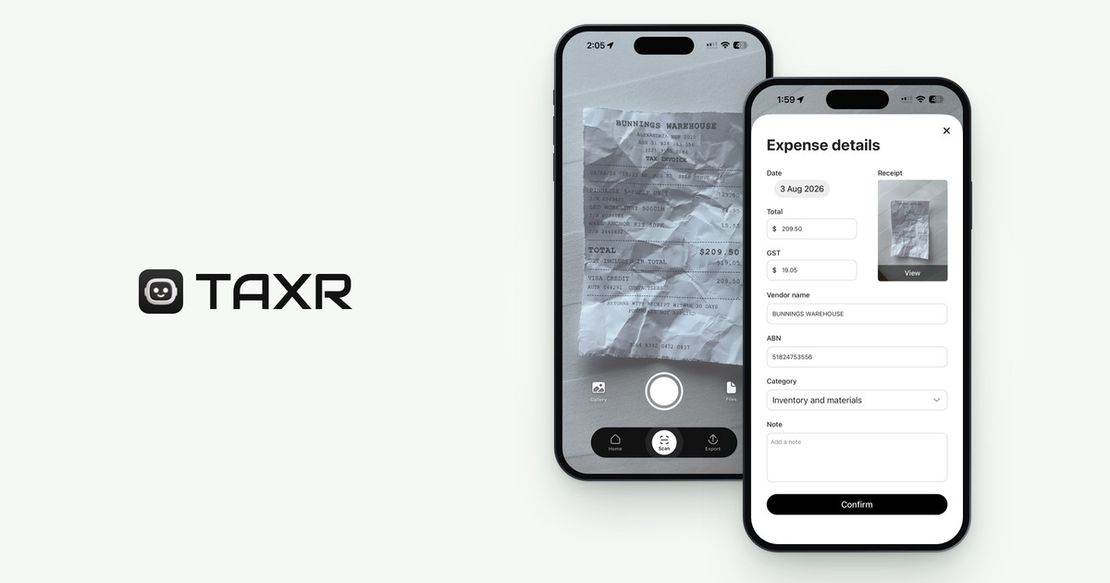
Let's be honest: the glovebox full of crumpled receipts is not a record-keeping system. Paper receipts fade, get wet, and disappear. The ATO requires you to keep records for five years, and they accept digital copies as valid evidence. A clear photo or scan of a receipt is just as good as the original, provided it shows:
- The supplier's name
- The date of purchase
- What was bought
- The amount paid
- The GST amount (if applicable)
The best habit is to scan every receipt the moment you get it: at the hardware store, the petrol station, the workwear shop. It takes a few seconds on your phone and means you'll never lose a deduction because a receipt faded or went through the wash.
For tradies, a receipt scanning app is particularly valuable because expenses happen on the go. You're not sitting at a desk with a filing cabinet; you're bouncing between job sites, picking up materials, and filling up the tank. Having a digital system that travels with you means every expense gets captured the moment it happens. Our page on Taxr for tradies lists the small purchases that most often go missing.
For more general tips on maximising your deductions, check out our guide on 5 tax deduction tips every freelancer should know.
Start Claiming What You've Earned
Between tools, vehicles, workwear, insurance, and the instant asset write-off, tradies have access to some of the most generous tax deductions available to any profession. The catch is always the same: you need the records. Taxr keeps it simple: scan your receipts on the job site with your phone, and the AI pulls out the details and suggests an ATO-aligned category for you to confirm. When it's time to lodge, export an Excel or PDF report for your tax agent, with no spreadsheet or shoebox required. Download Taxr and start keeping more of what you earn.