Tax Deductions for Teachers in Australia
Table of Contents
In short: Teachers in Australia can claim classroom supplies they pay for themselves, teaching resources and subscriptions, professional registration, union fees, professional development, and travel between schools on the same day. Each expense must be work-related and not reimbursed by the school. In 2025-26 you need receipts once work claims pass $300; from 2026-27 a $1,000 standard deduction needs none. The regular commute between home and school is not deductible.
Teachers in Australia are famously generous with their own money, spending hundreds of dollars each year on classroom supplies, resources, and professional development out of their own pockets. The good news is that these costs are tax-deductible, but many teachers only claim the obvious expenses and miss out on legitimate deductions worth hundreds of dollars. This guide covers every major tax deduction for teachers in Australia, from classroom supplies to home office claims.
Disclaimer: This article provides general information only and does not constitute tax advice. Consult a registered tax agent for advice specific to your circumstances.
Common Tax Deductions for Teachers
Teachers have a well-established set of deductions recognised by the ATO. The key rule is that the expense must be work-related, not reimbursed by your school, and you must be able to prove it: for 2025-26 that means a receipt, unless your work-related claims total $300 or less, in which case you need to show you spent the money and how you worked out the amount. From 2026-27, a $1,000 standard deduction for work-related expenses needs no receipts; if you claim more than $1,000 instead, you need records for all of it.
Classroom Supplies and Resources
If you buy supplies for your classroom out of your own pocket and are not reimbursed, you can claim them as a tax deduction. Common examples include:
- Stationery: pens, markers, whiteboard markers, chalk, sticky notes, folders, paper, laminating pouches
- Art and craft supplies: paint, brushes, clay, coloured paper, glue, scissors, fabric
- Printing and photocopying: costs for worksheets, handouts, and assessments (if paid personally)
- Books and readers: class sets, guided reading books, reference texts
- Classroom decorations: educational posters, wall displays, reward stickers, bulletin board materials
- Games and manipulatives: maths manipulatives, science kits, educational board games, flash cards
- Storage and organisation: plastic tubs, file organisers, label makers
A primary school teacher spending $50 per month on classroom supplies is looking at $600 per year in deductions, and that's conservative. Some teachers spend well over $1,000 annually on supplies their school doesn't cover.
Teaching Resources and Subscriptions
Digital teaching resources are increasingly common and fully deductible:
- Educational software subscriptions: Mathletics, Reading Eggs, Canva for Education (if you pay for a personal upgrade), Seesaw
- Teaching resource platforms: Teachers Pay Teachers, Twinkl, or similar sites where you purchase lesson plans, worksheets, and activities
- Educational apps: paid apps used on your personal device for classroom instruction
- Streaming services: if you pay for a service specifically to show educational content in class (claim the work-use percentage only)
Professional Registration
Teachers must be registered with their state or territory teacher registration board. The annual registration fee is fully tax-deductible:
- NSW: NSW Education Standards Authority (NESA)
- VIC: Victorian Institute of Teaching (VIT)
- QLD: Queensland College of Teachers (QCT)
- SA: Teachers Registration Board of South Australia (TRB)
- WA: Teacher Registration Board of Western Australia (TRBWA)
- TAS, NT, ACT: respective teacher registration bodies
Registration fees vary by state, so check the current fee with your registration body.
Union Fees
Membership fees for teaching unions are fully deductible:
- Australian Education Union (AEU): the largest teaching union in Australia
- Independent Education Union (IEU): for teachers in independent and Catholic schools
- State-based unions: NSWTF, VIEU, QTU, and others
Union fees vary by union and state, and they're an easy deduction to claim.
Professional Development
The ATO allows claims for self-education expenses that relate to your current teaching role:
- Courses and workshops: professional development days, curriculum workshops, pedagogy courses, subject-specific training
- Conferences: education conferences, subject association events, and seminars
- First aid certification: renewal costs for first aid and CPR qualifications (often required by schools)
- Working with Children Check: renewal fees in states where teachers pay for this
- Postgraduate study: if you're studying a qualification that directly relates to your current teaching role (e.g., a Master of Education while employed as a teacher), course fees and associated costs are deductible
Note: The training must relate to your current work. A maths teacher can claim a course on advanced mathematics pedagogy, but not a course on plumbing.
Excursion and Camp Costs
If you attend school camps, excursions, or overnight trips and are not reimbursed for personal costs, you may be able to claim:
- Meal costs on overnight camps and school trips (if not provided by the school). Meals on a day excursion are private, like any other meal during your working day
- Travel costs if you use your own vehicle to get to the camp or excursion venue
- Overnight expenses for multi-day camps where you incur out-of-pocket costs
These claims apply only to unreimbursed expenses. If the school covers all your costs, there's nothing to claim.
Home Office Deductions
Teachers spend a significant amount of time working from home: planning lessons, marking assignments, writing reports, and preparing resources. The ATO allows two methods:
Fixed Rate Method (70 cents per hour)
- Claim 70 cents for every hour you work from home (the rate for 2024-25 and 2025-26)
- Covers electricity, internet, phone, stationery, and computer consumables
- You still claim equipment depreciation separately
- Keep a record of hours worked from home
A teacher who spends 10 hours per week marking and lesson planning at home for 40 school weeks would claim $280 per year under this method. During report-writing periods, those hours often climb higher. To compare both methods with your own hours and costs, use our home office deduction calculator.
Actual Cost Method
- Calculate the actual proportion of household costs attributable to your home workspace
- Requires detailed records of your costs and how much of each is work-related
- Can result in a larger deduction if your costs are significant
For a deeper look, check out our home office deduction calculator guide.
Vehicle and Travel Expenses
Teachers can claim travel expenses in specific situations. The ATO provides guidance on motor vehicle expenses:
Deductible Travel
- Travel between workplaces: if you teach at two schools on the same day (e.g., a music teacher who works across multiple schools), travel between them is deductible
- Travel to professional development: if you attend a course, workshop, or conference at a location other than your school
- Trips to collect supplies: the ATO lists collecting supplies among the trips you can claim when you make them as part of your work duties, such as driving from school to a store to pick up materials for a lesson. Stopping at a shop on your way to or from school doesn't make that trip deductible, so check with your tax agent if you're unsure
- Excursion and camp travel: if you drive to the venue in your own car
Non-Deductible Travel
- Regular commute: travel from home to your school and back is not deductible
Claim using the cents per kilometre method (88 cents/km for 2024-25 and 2025-26, rising to 91 cents from 1 July 2026, capped at 5,000 km) or the logbook method. For most teachers, the cents per kilometre method is sufficient unless you work across multiple schools regularly.
Sun Protection
Teachers who spend time on outdoor duty (supervising lunch breaks, sports carnivals, swimming lessons, or playground supervision) can claim sun protection expenses:
- Sunscreen: if you apply it for outdoor duties
- Sun-protection hats: wide-brimmed hats worn during outdoor supervision
- Sunglasses: if used primarily for outdoor work duties (claim the work-related portion)
Equipment and Tools
Teachers often purchase technology and equipment for their work:
- Laptop or tablet: if you use a personal device for lesson planning, marking, creating resources, or accessing school systems. Items over $300 are depreciated over their effective life (2 years for laptops and tablets); items $300 or less are claimed immediately. Claim the work-related percentage.
- Printer: if you print teaching materials at home. Claim the work-use percentage of the device and consumables (ink, paper).
- USB drives, cables, and adapters: small items used for work
- Bags and cases: a work bag used to carry books, papers, and a laptop between home and school (claim the work-related portion)
- Phone: if you use your personal phone for work communication, school apps, or parent contact. Claim the work-related percentage.
Record-Keeping Tips for Teachers
The ATO requires records to be kept for five years. For teachers making frequent small purchases throughout the year, staying organised is essential.
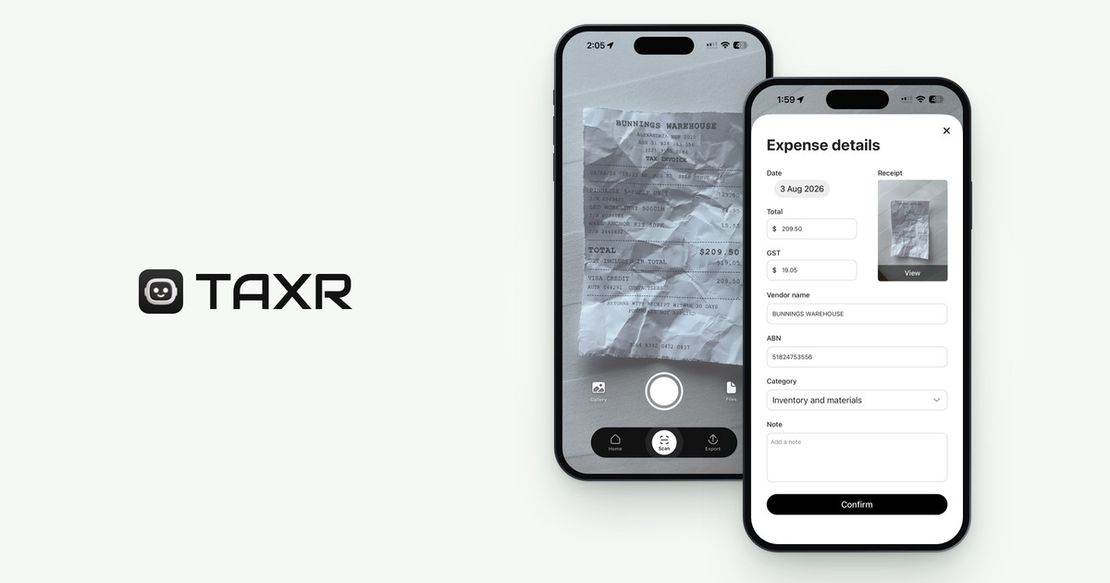
- Scan receipts immediately: every time you buy classroom supplies, scan the receipt on your phone. Paper receipts from Officeworks and craft stores fade quickly.
- Keep a home-office hours log: record the hours you spend marking, planning, and preparing at home. A simple diary or spreadsheet is sufficient.
- Save professional development certificates: keep proof of courses, workshops, and conferences attended.
- Track union and registration payments: these are annual expenses that are easy to overlook at tax time.
- Note which purchases are unreimbursed: if your school provides a budget for supplies, only claim expenses you've paid for yourself and have not been reimbursed.
For more general tips on maximising deductions, check out our guide on 5 tax deduction tips every freelancer should know.
Track Teacher Deductions with Taxr
Between classroom supplies, professional development, home office costs, and registration fees, teachers have a wide range of deductions available, but small, frequent purchases are the ones most likely to slip through the cracks. Taxr keeps this simple: scan each receipt with your phone the moment you leave the store, and the AI reads the details and suggests an ATO-aligned category for you to confirm. At EOFY, export an Excel or PDF summary for your tax agent instead of sorting through a shoebox of faded receipts in June. Download Taxr and start claiming every dollar you spend on your students.