Tax Deductions for Rideshare Drivers in Australia: The Complete Guide
Table of Contents
If you drive for Uber, Ola, DiDi, or any other rideshare platform in Australia, you’re running a small business – and that means you can claim a wide range of tax deductions for rideshare drivers in Australia. The trouble is, most drivers leave money on the table because they don’t realise what’s claimable or they don’t keep proper records. This guide covers every deduction you should know about.
Disclaimer: This article provides general information only and does not constitute tax advice. Consult a registered tax agent for advice specific to your circumstances.
What Can Rideshare Drivers Claim?
As a rideshare driver, your tax deductions for rideshare drivers in Australia fall into several broad categories:
- Vehicle running costs – fuel, servicing, registration, insurance, depreciation
- Phone and data expenses – the portion used for the driver app
- Platform fees – commissions and service fees charged by Uber, Ola, DiDi, etc.
- Miscellaneous expenses – tolls, car washes, dash cams, and more
The ATO treats rideshare driving as carrying on a business, which means you need to report your income and can offset it with legitimate business expenses. You’ll also need to register for GST regardless of how much you earn, since rideshare driving is classified as taxi travel. Let’s break down the major categories.
Vehicle Expenses – Logbook vs Cents per KM
Your car is your biggest business asset, and vehicle expenses will make up the bulk of your deductions. The ATO allows two methods for calculating your car expense deduction:
Cents per Kilometre Method
- Claim 85 cents per business kilometre (2023-24 rate)
- Capped at 5,000 business kilometres per year
- Maximum claim of $4,250 per year
- No receipts required, but you need to be able to show how you calculated your kilometres
For most rideshare drivers, this method is too limiting. If you drive even part-time, you’ll likely exceed 5,000 business kilometres well before the end of the financial year.
Logbook Method
- Keep a logbook for a minimum of 12 consecutive weeks
- Record every trip during the logbook period – both personal and business
- Calculate your business-use percentage
- Apply that percentage to all running costs for the year
Running costs you can claim under the logbook method include:
- Fuel and oil
- Registration and CTP insurance
- Comprehensive car insurance
- Servicing, repairs, and tyres
- Car loan interest (not the principal)
- Depreciation of the vehicle
- Roadside assistance (NRMA, RACV, etc.)
For high-kilometre drivers, the logbook method almost always delivers a larger deduction. A driver who puts 30,000 km on the car with an 80% business-use percentage can claim 80% of all running costs – often well over $10,000 in deductions.
Tip: Your logbook is valid for five years, provided your circumstances don’t change significantly. If your driving pattern shifts – say you go from part-time to full-time – you’ll need to start a new logbook.
Phone and Data Expenses
Your smartphone is essential for rideshare work. You use it to accept trips, navigate, and communicate with passengers. The ATO lets you claim the work-related portion of your phone and data costs.
To work out the percentage:
- Review your usage over a representative four-week period
- Estimate the work-related proportion – consider hours spent with the rideshare app active versus personal use
- Apply that percentage to your monthly phone bill and any handset repayments
For example, if your monthly phone plan costs $60 and you determine that 50% of your usage is for rideshare driving, you can claim $30 per month, or $360 per year.
If you purchased a phone specifically for rideshare work, you can claim the work-related portion of the cost. Phones costing $300 or less can be claimed as an immediate deduction. For phones over $300, you’ll need to depreciate the cost over the effective life (typically three years).
Other Deductions Drivers Often Miss
Beyond vehicle and phone expenses, there’s a long list of smaller deductions that add up quickly:
- Tolls – any tolls incurred while carrying passengers or driving to pick up a passenger are fully deductible
- Parking – parking fees while you’re working (but not fines – the ATO doesn’t cover your parking tickets)
- Car cleaning – interior and exterior washes to keep your car presentable for passengers
- Car phone mount – a mount for your smartphone is an immediate deduction
- Dash cam – if you use one for safety while driving, the work-use portion is deductible
- Sunglasses – prescription sunglasses used for driving are partially deductible (the work-use portion)
- Water and snacks for passengers – if you provide these to improve your rating, they’re a legitimate business expense
- First aid kit – a deductible safety expense
- Sanitiser and cleaning supplies – keeping your car hygienic for passengers
- Accounting and tax agent fees – the cost of having your tax return prepared is deductible in the following year
Don’t dismiss the small items. A driver spending $20 per week on car washes, $10 on water and mints, and $15 on tolls is looking at over $2,300 in additional deductions per year – but only if the receipts are kept.
Record-Keeping Requirements for the ATO
The ATO requires you to keep records for five years from the date you lodge your tax return. For rideshare drivers, this means:
- Receipts or invoices for every expense you claim
- A valid logbook if using the logbook method for car expenses
- Income statements from your rideshare platform (Uber provides an annual tax summary)
- BAS records showing your GST obligations
The good news is the ATO accepts digital records. You don’t need to hoard paper receipts in your glovebox – a clear photo or scan of each receipt is perfectly valid. What matters is that the record shows:
- The name of the supplier
- The amount of the expense
- The nature of the goods or services
- The date of the expense
- The GST amount (if applicable)
Getting into the habit of scanning receipts immediately after each purchase is the easiest way to stay on top of your records. It takes seconds and saves hours of stress at tax time.
How Taxr Simplifies Receipt Tracking for Drivers
Rideshare drivers deal with a high volume of small, frequent expenses – fuel top-ups, car washes, tolls, snacks. That’s exactly the kind of spending that’s easy to lose track of.
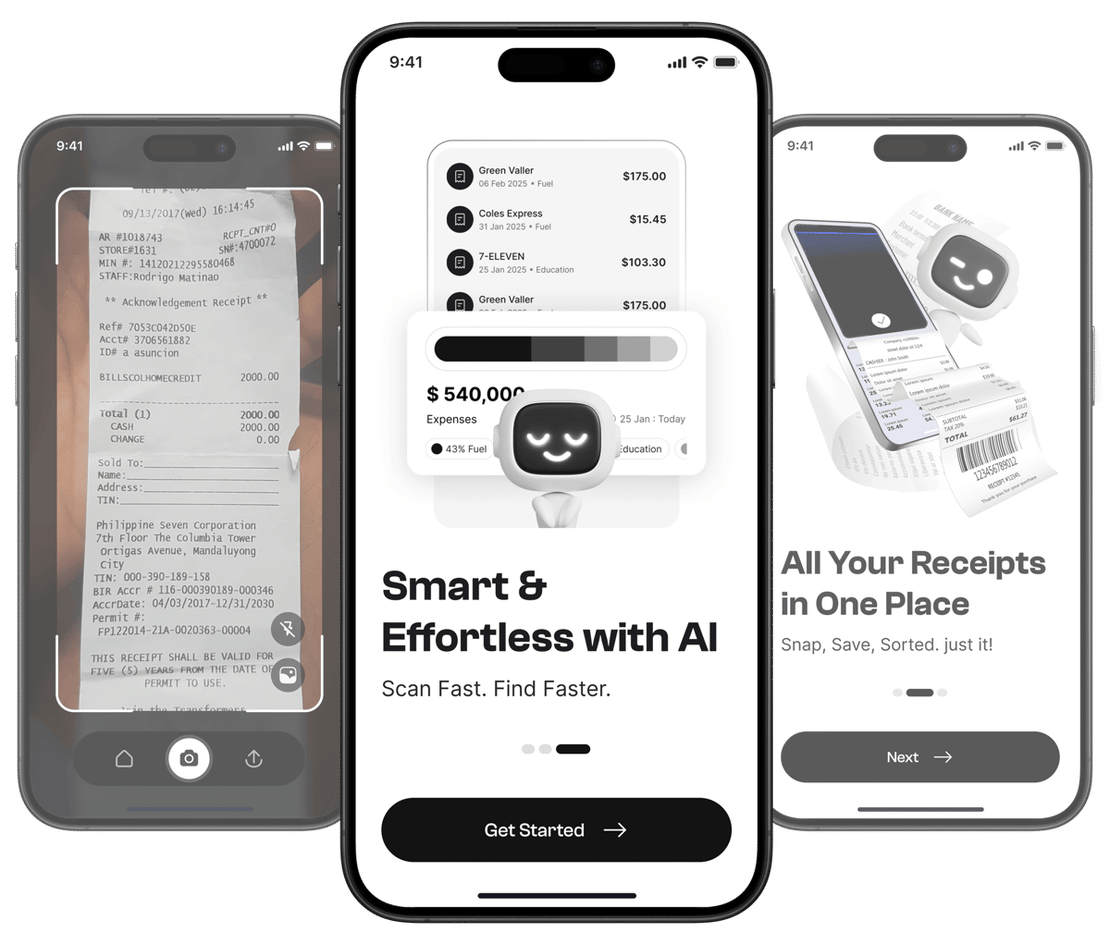
With Taxr, you can scan a fuel receipt or car wash docket in seconds. The AI reads the receipt and automatically extracts the date, amount, vendor, and GST. Each receipt is categorised and stored securely in the cloud, so you’ll never have to dig through your centre console looking for a faded thermal receipt again.
When tax time arrives, export your full expense report and hand it to your tax agent. Everything is organised, categorised, and ready to go – no spreadsheets, no shoeboxes.
If you’re already tracking your deductions well, check out our guide on 5 tax deduction tips every freelancer should know for even more ways to maximise your return.
Start Tracking Your Deductions Today
Every receipt you don’t keep is a deduction you can’t claim. For rideshare drivers, those missed deductions add up fast – often to thousands of dollars per year. Taxr makes it simple: scan your receipts on the go, let the AI handle the data entry, and export a clean summary for your tax agent when it’s time to lodge. Download Taxr and start claiming what you’re owed.