Tax Deductions for Real Estate Agents: A 1099 Guide
Table of Contents
In short: US real estate agents working as 1099 independent contractors can deduct vehicle expenses (for most agents, the largest deduction of the year), MLS and board dues, license renewals and continuing education, marketing, signage and listing photography, staging costs and brokerage desk fees. Client gifts are capped per person, and ordinary business attire and the personal-use share of the car don't count.
Between three showings, a listing photo shoot, and an open house across town, most agents put more miles on their car in a week than plenty of people put on in a month, and that's before counting MLS dues, sign installs, and the marketing spend that goes out before a single commission comes in. As an independent contractor working under a brokerage, that income and those costs flow through your own Schedule C, not the brokerage's books.
Disclaimer: This article provides general information only and does not constitute tax advice. Consult a tax professional, such as a CPA or enrolled agent, about your circumstances.
Here's what real estate agents can typically deduct, and where the IRS draws firmer lines.
Deductions Real Estate Agents Can Claim
- Vehicle expenses. For most agents, this is the single largest deduction of the year: showings, listing visits, client pickups, and inspections add up fast. You'll generally choose between the standard mileage method and the actual expense method; see our mileage tracking guide for how to log trips correctly and pick the method that fits your driving.
- MLS and board dues. Multiple listing service fees and local or national association dues (NAR and equivalents) are a direct cost of doing business.
- Licensing renewals and continuing education. State license renewal fees and the continuing education hours required to keep your license active are deductible.
- Marketing, signage, and photography. Yard signs, postcards, digital ad spend, and professional listing photography or video are all marketing costs tied directly to closing deals.
- Staging costs. Furniture rental and staging consultant fees for a listing are deductible business expenses, not personal decorating costs.
- Client gifts. Closing gifts for clients are deductible, but the IRS caps how much of a gift to any single person you can write off in a year. The exact limit is worth confirming at irs.gov or with a tax professional before you budget a big one.
- Open-house expenses. Flyers, directional signage rental, and light refreshments for an open house are deductible marketing costs.
- Errors and omissions insurance. E&O coverage is close to a universal cost for agents and is fully deductible.
- Brokerage desk fees. Monthly desk fees, franchise fees, or transaction fees your brokerage charges you are a deductible cost of operating under that brokerage.
- Phone. The business-use portion of your phone plan, given how much of an agent's day runs through calls and texts with clients and other agents.
- Home office, if you don't have dedicated desk space at your brokerage and use part of your home regularly and exclusively for paperwork, prep, and client calls.
- Transaction coordinators and administrative support. If you pay someone to manage paperwork, coordinate closings, or handle listing admin, that's a deductible business cost, and if you pay one contractor enough over the year, you may have your own reporting obligations to them.
- Lockboxes, key access tools, and showing software. Electronic lockbox fees and apps used to schedule and track showings are ordinary costs of running a listing business.
Real estate is unusual among 1099 professions in how front-loaded the spending is: marketing, staging, and photography all go out before a deal closes, sometimes months before you see a commission. Every one of those upfront costs is still deductible in the year you paid it, regardless of when, or whether, the listing eventually sells.
What Doesn't Count
The personal-use portion of your car (weekend errands, the school run, anything unrelated to a specific business purpose) isn't deductible, and you need a reasonable basis for the split you claim. Clothing doesn't become deductible just because you consider it "professional" for client-facing work; the IRS treats ordinary business attire as personal, even if you'd never wear it outside of work. Entertaining friends at an open house you're hosting anyway isn't the same as a genuine business open house cost. And client gifts beyond the per-person cap mentioned above simply aren't deductible past that limit, no matter how generous the gesture.
Self-Employment Tax and Quarterly Payments
As an independent contractor, your commission income is subject to self-employment tax in addition to regular income tax. See our guide to how self-employment tax works for the mechanics. Because commissions are irregular and no one withholds tax from them, most agents need to make estimated payments throughout the year; our quarterly estimated tax date guide covers when those are due. Every deduction above lowers both numbers.
Keeping Records the IRS Will Accept
A staging invoice from a slow month and a yard sign receipt from a rush closing both need somewhere to live besides your center console or a folder you'll never open again. The IRS accepts digital copies of receipts as valid records, and the general guidance is to keep them for at least three years. Our guide to what receipts the IRS requires covers what documentation actually holds up if you're ever asked to substantiate a deduction.
How Taxr Helps Agents Stay Organized Between Closings
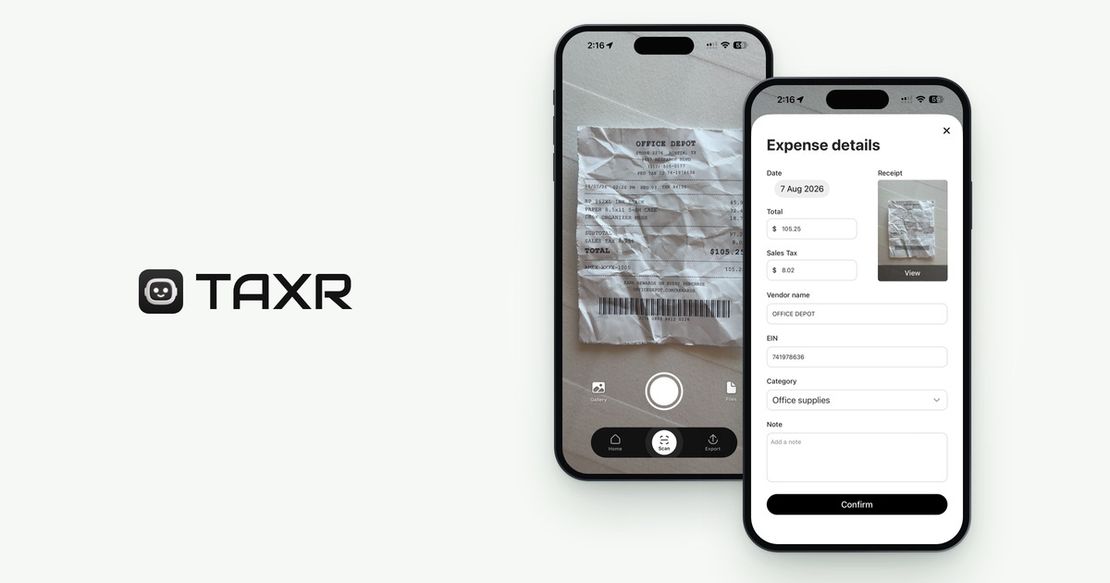
Real estate is one of the most expense-heavy 1099 professions out there. Marketing, staging, signage, dues, and fuel all hit at different points in a deal, often before you've been paid a cent. Taxr lets you photograph a receipt the moment you get it, like a gas station stop between showings, or import a staging invoice that arrives by email as a PDF or screenshot. The AI reads it and suggests a Schedule C category, which you confirm.
When it's time to file, export an Excel or PDF report by category to work from in your tax software or to send to your tax pro. Our comparison of receipt scanner apps covers how automated capture stacks up, and our page for freelancers covers how Taxr fits independent-contractor workflows more broadly.
Every showing, staging invoice, and open-house flyer you don't track is a deduction quietly slipping past you. Download Taxr and keep your records closing-ready all year, not just in April.