Tax Deductions for Personal Trainers in Australia
Table of Contents
In short: Personal trainers in Australia, employed by a gym or running their own PT business, can claim most of the costs of their work. The biggest deductions are fitness equipment, certifications and CPD for their current work, insurance premiums, and travel between clients, gyms and outdoor locations. Plain activewear and sports shoes are not deductible, and travel from home to the first client is generally a non-deductible commute.
Personal training is a physically demanding profession, and an expensive one. Between gym rent, equipment, certifications, insurance, and travel between clients, the costs stack up fast. The good news is that most of those costs are legitimate tax deductions for personal trainers in Australia, and claiming them properly can put thousands of dollars back in your pocket each year. This guide breaks down every major deduction category so you know exactly what to claim.
Disclaimer: This article provides general information only and does not constitute tax advice. Consult a registered tax agent for advice specific to your circumstances.
Fitness Equipment Deductions
If you supply your own equipment for client sessions, those costs are deductible. How you claim depends on what each item costs:
- Items costing $300 or less, if you're employed by a gym: claim an immediate deduction in the year of purchase for items you use mainly for that job. This covers most portable equipment: resistance bands, yoga mats, foam rollers, skipping ropes, agility ladders, and lighter dumbbells. This rule doesn't apply to equipment used in your own PT business.
- Items costing more than $300: if you're an employee, or your business doesn't use the simplified depreciation rules, depreciate the cost over the item's effective life. For example, a $1,500 set of adjustable dumbbells with the ATO's 6-year effective life for free weights would give you a $250 deduction per year under the prime cost method.
- Instant asset write-off: if you operate as a sole trader or small business with aggregated turnover under $10 million and use the simplified depreciation rules, you can claim the business-use share of each item costing less than $20,000 in full in the year you first use it, from resistance bands to that $1,500 set of dumbbells. Items costing $20,000 or more go into the small business pool. Check the ATO's instant asset write-off page for current thresholds.
Common equipment deductions for personal trainers include:
- Dumbbells, kettlebells, and barbells
- Resistance bands, TRX suspension trainers, and battle ropes
- Exercise mats, stability balls, and foam rollers
- Boxing pads, gloves, and bags
- Portable speakers for outdoor sessions
- Heart rate monitors or fitness trackers used with clients
- Portable storage (trolleys, bags, or crates for transporting equipment)
Example: A personal trainer who buys a TRX system for $280, a set of resistance bands for $90, and a Bosu ball for $150 can claim the full $520 as an immediate deduction, under the $300 rule if they're employed by a gym or under the instant asset write-off if they run their own PT business.
Professional Certifications and CPD
The fitness industry requires ongoing education, and these costs are fully deductible when they relate to your current work:
- Maintaining existing qualifications: Cert III and Cert IV in Fitness renewal costs, first aid and CPR recertification
- Specialisation courses: pre- and post-natal training, strength and conditioning, nutrition, group fitness, boxing, Pilates, or yoga instructor courses (provided they relate to your current income-earning activity)
- Continuing Professional Development (CPD): courses, workshops, and seminars required to maintain your registration points
- Conference attendance: including registration fees, travel, and accommodation for industry events like FILEX or AUSactive conferences
Important: The ATO distinguishes between maintaining or improving existing skills (deductible) and gaining qualifications for a new profession (not deductible). If you're already a qualified PT and take a nutrition specialisation course to offer better service to your existing clients, that's deductible. If you're studying a completely new field like physiotherapy, it's not.
Registration and Membership Fees
Professional registration fees are deductible, including:
- AUSactive (formerly Fitness Australia) registration: the annual fee to maintain your industry registration
- First aid certification fees: required to maintain your PT registration
- Working with Children Check: if required for your work
- Professional association memberships: any fitness industry body relevant to your practice
- Gym or studio memberships: but only the portion used for work purposes (training clients, not your own personal workouts)
Insurance Premiums
Insurance is non-negotiable for personal trainers, and the premiums are deductible:
- Public liability insurance: covers you if a client is injured during a session or someone trips over your equipment in a park.
- Professional indemnity insurance: covers claims arising from your professional advice (e.g., a client alleges your programming caused an injury)
- Income protection insurance: premiums are deductible, though any payout is treated as assessable income
- Equipment insurance: if you insure your gear against theft or damage
A personal trainer paying $250 for public liability, $200 for professional indemnity, and $150 for equipment insurance can claim $600 in insurance deductions.
Branded Clothing and Uniforms
Clothing deductions for personal trainers have strict rules. You can claim:
- Branded uniforms: shirts, jackets, or caps with your business name, logo, or branding. The ATO requires the branding to be permanently attached (printed, embroidered, or similar) and clearly identify you as working for a particular business.
- Protective footwear: only footwear with protective features against a specific risk of your work, such as steel-capped boots. Sports shoes, including running or aerobic shoes, count as conventional clothing and aren't deductible, even if you only wear them to train clients.
- Sun protection: hats, sunscreen, and sun-protective clothing if you work outdoors regularly
What you can't claim: Plain activewear, even if you only wear it for work. A pair of black leggings or a generic gym shirt is not deductible unless it carries your business branding. The ATO's clothing and laundry expenses guidance is clear on this point.
You can also claim laundry costs for eligible branded uniforms. Up to the 2025-26 income year, claims of up to $150 don't need written evidence, and you can claim more if you keep a laundry diary. From 1 July 2026 that $150 exception ends, so keep a laundry diary for any laundry you claim.
Vehicle and Travel Expenses
If you travel between clients, gyms, or outdoor training locations during the day, those travel costs are deductible. The ATO offers two methods:
Cents per Kilometre Method
- 88 cents per business kilometre for 2024-25 and 2025-26 (91 cents from 1 July 2026)
- Capped at 5,000 km per year
- Maximum claim of $4,400 ($4,550 for 2026-27)
Logbook Method
- Keep a logbook for at least 12 consecutive weeks
- Calculate your business-use percentage
- Claim that percentage of all running costs: fuel, rego, insurance, servicing, depreciation, and loan interest
For mobile personal trainers who drive between multiple client locations each day, the logbook method almost always produces a larger deduction. A PT travelling to four or five different locations per day could easily clock 20,000+ business kilometres per year. To check the cents per kilometre figure for your own kilometres, use our cents per km calculator.
Note: Travel from home to your first client and from your last client back home is generally treated as a commute and is not deductible, unless your home is your base of business operations or you carry bulky equipment that can't be stored securely where you train.
Home Office Deductions
Many personal trainers do programming, admin, invoicing, and client communication from home. If you do this work at home, you can claim home office expenses:
- Fixed rate method: 70 cents per hour (the rate for 2024-25 and 2025-26) for every hour you work from home, covering energy costs, phone, internet, stationery, and computer consumables
- Actual cost method: calculate the actual costs of running your home office, including a proportional share of electricity, internet, phone, and depreciation of office furniture and equipment
Even if you only spend an hour a day doing programming and admin at home, that adds up. At 70 cents per hour for 250 working days, that's $175 per year, just for the home office portion. To compare both methods with your own hours and costs, use our home office deduction calculator.
Phone, Internet, and Software
Your phone is an essential business tool: client communication, scheduling, payments, and social media all run through it. You can claim the business-use percentage of:
- Phone bills: calls and data used for client bookings, scheduling, and communication
- Internet: the work-related portion of your home internet
- Music subscriptions: if you use Spotify, Apple Music, or similar services to play music during group classes or PT sessions, the work-use portion is deductible
- Scheduling and booking software: platforms like Mindbody, Acuity, or Calendly
- Payment processing apps: Square, Stripe, or other payment tools
- Social media management tools: if you use paid tools for business marketing
Gym Rent and Facility Hire
If you rent space in a gym, studio, or community hall to train clients, those costs are fully deductible:
- Gym floor rent or sublease payments
- Studio hire for group classes
- Park or council facility hire fees
- Equipment storage costs at a gym or facility
Some PTs pay a flat monthly fee to operate out of a gym; others pay per session or per client. Either way, the cost is deductible.
Marketing and Advertising
Getting clients requires marketing, and those costs are deductible:
- Business website hosting, domain, and design costs
- Social media advertising (Facebook, Instagram, Google Ads)
- Business cards and flyers
- Photography or videography for promotional material
- Online directory listings
- Referral fees or affiliate commissions
Record-Keeping Tips for Personal Trainers
The ATO requires you to keep records for five years, and digital copies of receipts are accepted. For personal trainers who are constantly on the move, a digital system is essential: you're not going to sort through a pile of paper receipts at the end of the financial year.
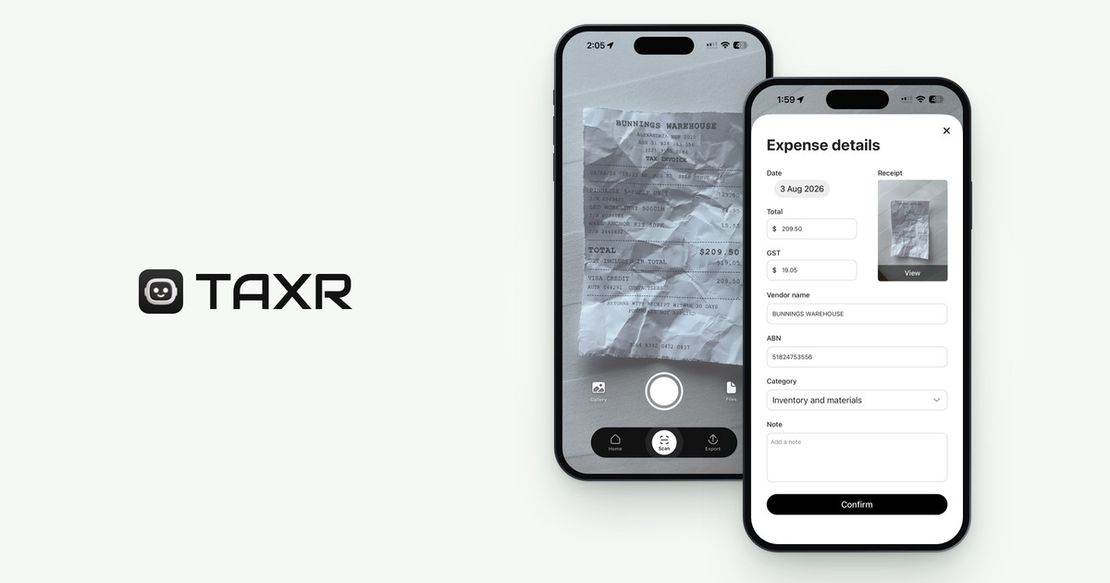
Get into the habit of scanning every receipt the moment you get it: equipment purchases, fuel stops, insurance renewals, certification payments. A photo on your phone is all it takes, but a dedicated receipt scanning app will organise everything by category and make tax time painless.
For more general tips on maximising your deductions, check out our guide on 5 tax deduction tips every freelancer should know. The 2026-27 Federal Budget included changes that affect sole-trader service workers like PTs. See the 2026 Budget guide for personal trainers and service workers for what's relevant to your situation.
Start Claiming What You're Entitled To
Between equipment, certifications, insurance, travel, and facility costs, personal trainers have a wide range of deductions available, but only if you keep the records to back them up. Taxr makes it simple: scan your receipts with your phone between sessions, and the AI reads each one and suggests an ATO-aligned category for you to confirm. At EOFY, export an Excel or PDF report for your tax agent, with no spreadsheet or shoebox involved. Download Taxr and start keeping more of what you earn.