Tax Deductions for Musicians and Artists in Australia
Table of Contents
In short: Musicians and artists in Australia can claim instruments and equipment, studio and rehearsal space, recording and production costs, travel to gigs and performances, agent and manager commissions, performance costumes, and marketing. Everyday clothing isn't deductible, even if you wear it on stage. If you qualify as a special professional, the income averaging rules in Division 405 keep a good year from being taxed at a disproportionately high rate.
If you gig on weekends, tour nationally, paint commissions, or teach music lessons, the costs of being a creative professional in Australia add up quickly. Instruments, studio time, agent fees, travel, costumes, and supplies all eat into your income, but they're also legitimate tax deductions for musicians and artists in Australia. This guide covers every major deduction category and some unique tax rules that apply specifically to creative professionals.
Disclaimer: This article provides general information only and does not constitute tax advice. Consult a registered tax agent for advice specific to your circumstances.
Instruments and Equipment
Musical instruments and creative equipment are among the largest expenses for artists, and they're deductible. How you claim depends on cost:
- Items costing $300 or less, if you're an employee: if you're paid wages for your music or art (for example, as an orchestra member), you can claim an immediate deduction in full for an item costing $300 or less that you use mainly for that job. The ATO's own example is an orchestral violinist claiming a $200 bow. This rule doesn't apply to equipment you use in your own business.
- Items costing more than $300: if you're an employee, or your business doesn't use the simplified depreciation rules, depreciate the cost over the item's effective life. The ATO sets effective life estimates for different instrument types. For example, an acoustic keyboard such as a piano has an effective life of 10 years and an electric keyboard or synthesiser 5 years, while brass, woodwind, and stringed instruments are 10 years. A $3,000 guitar depreciated over 10 years gives you a $300 deduction per year under the prime cost method.
- Instant asset write-off: if you gig, teach or sell your work through your own business, your aggregated turnover is under $10 million and you use the simplified depreciation rules, you can claim the business-use share of each instrument or piece of equipment costing less than $20,000 in full in the year you first use it. This is particularly valuable for big purchases like a piano, drum kit, or PA system. Anything costing $20,000 or more goes into the small business pool (15% in the first year, 30% after).
Common equipment deductions include:
- Musical instruments (guitars, keyboards, drums, brass, woodwind, strings)
- Amplifiers, PA systems, and stage monitors
- Microphones, stands, and cables
- Easels, kilns, and printmaking presses (for visual artists)
- Art supplies: paint, canvas, clay, ink, paper, framing materials
- Recording equipment (audio interfaces, studio monitors, MIDI controllers)
- Camera and video equipment (for visual artists documenting work)
Tip: If you buy a second-hand instrument, the cost is still deductible. The instant asset write-off applies to used assets as well as new ones.
Studio and Rehearsal Space
If you rent a studio, rehearsal room, or workshop, the cost is fully deductible:
- Studio or rehearsal space rent (weekly, monthly, or per-session rates)
- Storage costs for instruments, props, or art supplies
- Workshop rent for visual artists (including shared studio spaces)
- Electricity and utilities for a rented studio (if you pay them separately)
If you use part of your home as a dedicated studio or practice room, you may be able to claim home office deductions (more on that below).
Recording and Production Costs
If you record music, produce content, or create finished works, the associated costs are deductible:
- Studio recording session fees (hiring a professional studio and engineer)
- Mixing and mastering fees
- Session musician fees
- Producer fees
- Manufacturing costs for physical releases (CDs, vinyl, prints)
- Digital distribution fees (DistroKid, TuneCore, CD Baby)
- Streaming platform fees and hosting costs
Travel to Gigs and Performances
Travel is a significant expense for touring musicians and artists who exhibit or perform at different venues. Deductible travel expenses include:
- Vehicle expenses: using either the cents per kilometre method (88 cents per km for 2025-26 and 91 cents from 1 July 2026, capped at 5,000 km) or the logbook method for travel between gigs, rehearsals, and performance venues. The ATO details both methods.
- Flights and public transport: for interstate or regional performances, exhibitions, or residencies
- Accommodation: when you need to stay overnight for a performance, tour, or exhibition opening
- Meals: when you're travelling overnight for work (reasonable amounts)
- Tolls and parking: at venues, studios, or rehearsal spaces
- Equipment transport: trailer hire, freight costs, or excess baggage charges for instruments and gear
For musicians who gig regularly, the logbook method for vehicle expenses usually produces the best result because you'll exceed 5,000 business kilometres well before the year is out.
Agent and Manager Commissions
If you use a booking agent, manager, or gallery to represent you, their commissions are deductible. This typically ranges from 10% to 20% of your gross earnings, depending on the arrangement. Deductible fees include:
- Booking agent commissions
- Artist manager fees
- Gallery commissions on sales
- Publicist or PR retainer fees
- Casting agent fees (for performing artists)
Make sure you get clear invoices or statements showing the commission amounts, because you'll need them at tax time.
Costumes, Makeup, and Performance Clothing
Costumes and performance clothing are deductible, but the rules are specific:
- Costumes and stage clothing: items that are specifically designed for performance and not suitable for everyday wear are deductible. A sequined stage jacket or a theatrical costume clearly qualifies.
- Makeup: stage or performance makeup is deductible. Everyday makeup is not, even if you wear it for a performance.
- Wigs, hairpieces, and accessories: if required for a specific role or performance
What you can't claim: Everyday clothing, even if you wear it on stage. A plain black shirt worn at a jazz gig is not deductible unless it has specific branding or is recognisably a costume piece.
Software and Digital Tools
Creative professionals rely heavily on software, and subscriptions are deductible:
- Music production: Logic Pro, Ableton Live, Pro Tools, FL Studio, GarageBand plugins
- Visual arts: Adobe Creative Cloud (Photoshop, Illustrator, InDesign), Procreate, Clip Studio Paint
- Video editing: DaVinci Resolve, Final Cut Pro, Adobe Premiere
- Accounting and invoicing: Xero, MYOB, or Wave for managing your finances
- Website builders: Squarespace, WordPress hosting, or similar for your portfolio site
Marketing and Promotion
Getting your work in front of people costs money, and those marketing expenses are deductible:
- Website hosting, domain, and design
- Social media advertising (Instagram, Facebook, TikTok ads)
- EPK (Electronic Press Kit) creation
- Press photos and promotional video
- Posters, flyers, and print materials
- Streaming platform promotion (Spotify for Artists campaigns)
- Email marketing tools (Mailchimp, ConvertKit)
Professional Memberships and Insurance
Industry memberships and insurance premiums are deductible:
- APRA AMCOS: if you're a songwriter or composer, your membership fee is deductible
- MEAA (Media, Entertainment & Arts Alliance): union membership fees
- NAVA (National Association for the Visual Arts): for visual artists
- Instrument insurance: covering theft, loss, or damage to your instruments and equipment
- Public liability insurance: essential for performing at venues or running workshops
- Professional indemnity insurance: if you teach or provide creative direction
Income Averaging for Artists: Division 405
One of the most valuable (and often overlooked) tax provisions for creative professionals is the special income averaging rules under Division 405 of the Income Tax Assessment Act 1997. These rules recognise that artists often have wildly fluctuating income (a big commission one year, very little the next) and prevent you from paying a disproportionately high tax rate in a good year.
Key points:
- Who qualifies: you must be a "special professional" as defined by the ATO, which includes authors, musicians, performing artists, production associates, sportspeople, and inventors
- How it works: the ATO compares this year's taxable professional income with your average for the previous four years. The amount above that average is taxed at the rate that would apply if only one-fifth of it were added to your other income, so a spike in one year doesn't push all of it into a higher tax bracket
- No election, but you must report it: you don't elect into averaging, and the ATO does the calculation, but only from the taxable professional income you show in the supplementary section of your tax return (your professional income less the deductions that relate to it). Make sure that figure is in your return
- Talk to your tax agent: income averaging can be complex and interacts with other parts of the tax system. A tax agent experienced with creative professionals will know how to apply it correctly
The ATO has detailed guidance on income averaging for special professionals. If your income varies significantly from year to year, this provision could save you a meaningful amount of tax.
Home Office Deductions
Many musicians practice at home, and visual artists often work from a home studio. If you work from home, you can claim:
- Fixed rate method: 70 cents per hour (the rate for 2024-25 and 2025-26) for every hour you work from home, with no dedicated room needed
- Actual cost method: calculate the actual proportion of your electricity, internet, phone, and depreciation of furniture used for work
For a musician who practises for two hours a day and does an hour of admin (booking, social media, invoicing), that's three hours per day. At 70 cents per hour over 250 days, that's $525 per year. To compare both methods with your own hours and costs, use our home office deduction calculator.
Record-Keeping for Creative Professionals
The ATO requires you to keep records for five years. For musicians and artists, expenses happen in chaotic environments: you're buying strings before a gig, paying for parking at a venue, or picking up art supplies between commissions. Paper receipts get lost, damaged, or forgotten.
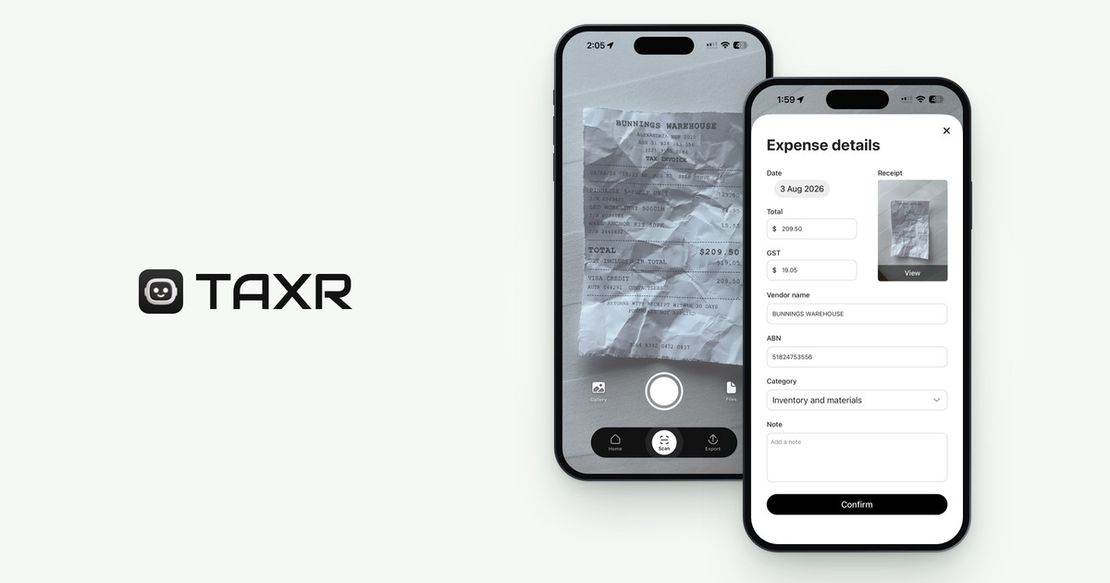
Digital receipt scanning solves this. A quick photo of each receipt the moment you get it means every expense is captured and categorised. When tax time rolls around, you'll have a complete picture of your deductions rather than a scramble to reconstruct what you spent.
For more general tips on claiming deductions, check out our guide on 5 tax deduction tips every freelancer should know.
Start Claiming What You're Entitled To
Between instruments, studio costs, travel, agent fees, and the special income averaging rules, musicians and artists have access to a unique range of tax deductions, but only if you keep the records. Taxr keeps this simple: scan your receipts after a gig or a supply run, let the AI read each one and suggest an ATO-aligned category for you to confirm, and export an Excel or PDF report for your tax agent at EOFY. Download Taxr and start keeping more of what you earn.