Tax Deductions for Freelance Graphic Designers in Australia
Table of Contents
Freelance graphic designers in Australia have a surprisingly long list of tax deductions available to them – but many creatives only claim the obvious ones and miss out on legitimate claims worth hundreds of dollars. If you’re a freelance designer earning income from your creative work, this guide covers the full range of tax deductions graphic designers in Australia can claim to reduce their tax bill.
Disclaimer: This article provides general information only and does not constitute tax advice. Consult a registered tax agent for advice specific to your circumstances.
Software Subscriptions You Can Claim
As a graphic designer, software is one of your biggest ongoing costs – and it’s fully deductible. If you use a subscription for work purposes, you can claim it. Common examples include:
- Adobe Creative Cloud – Photoshop, Illustrator, InDesign, After Effects, and the full suite
- Figma – increasingly the go-to for UI/UX design work
- Canva Pro – if you use it for client deliverables or social media work
- Sketch – for Mac-based UI design
- Stock photo and video subscriptions – Shutterstock, Adobe Stock, iStock, Envato Elements
- Font licences – individual fonts or subscriptions like Adobe Fonts, Fontstand, or MyFonts
- Project management tools – Asana, Trello, Monday, or Notion (the work-use portion)
- Cloud storage – Dropbox, Google Workspace, or iCloud (the work-use portion)
- Accounting software – Xero, MYOB, or QuickBooks
If a subscription is used partly for personal purposes, you can only claim the work-related percentage. For example, if you use Adobe Creative Cloud 80% for client work and 20% for personal projects, you claim 80% of the cost.
A designer running Adobe Creative Cloud ($90/month), Figma ($22/month), a stock photo subscription ($30/month), and a font subscription ($10/month) is looking at roughly $1,824 per year in software costs alone – all deductible if used for work.
Hardware and Equipment Depreciation
Designers rely on high-quality hardware. The good news is you can claim the work-related portion of your equipment costs, but the method depends on the price:
- Items costing $300 or less – claim an immediate deduction in the year of purchase
- Items costing more than $300 – depreciate over the item’s effective life, or use the instant asset write-off if you’re eligible as a small business
Common hardware deductions for designers include:
- Computers and laptops – a MacBook Pro or iMac is a core business tool (effective life: 4 years)
- External monitors – especially high-resolution displays for colour-accurate work
- Graphics tablets – Wacom, Huion, or iPad Pro with Apple Pencil
- Cameras – if you shoot reference photos, textures, or content for client work
- Printers – inkjet or laser printers for proofing
- External hard drives and SSDs – for backup and file storage
- Ergonomic accessories – a quality mouse, keyboard, or desk (if used for work)
The ATO provides a guide to depreciation and effective life for different asset types. For items used partly for personal purposes, remember to only claim the work-related percentage.
Example: You buy a $3,500 MacBook Pro and use it 90% for work. Over a 4-year effective life, you’d claim $787.50 per year ($3,500 x 90% / 4 years) as a depreciation deduction.
Home Office Deductions for Designers
Most freelance designers work from home at least some of the time. The ATO allows two methods for claiming home office expenses:
Fixed Rate Method (67 cents per hour)
- Claim 67 cents for every hour you work from home
- Covers electricity, internet, phone, stationery, and computer consumables
- You still claim equipment depreciation separately
- You need a record of hours worked from home (a timesheet, diary, or roster)
A designer working from home 35 hours per week for 48 weeks would claim $1,126.80 per year under this method.
Actual Cost Method
- Calculate the actual percentage of household costs attributable to your work
- Requires detailed records of all expenses (electricity bills, internet bills, rent or mortgage interest if applicable)
- You need a dedicated workspace – a desk in the corner of a bedroom counts, but the couch does not
- Can result in a larger deduction if your home office costs are high
The fixed rate method is simpler, but the actual cost method can be worthwhile if you have a dedicated studio space and high running costs. Whichever method you choose, keep thorough records.
For a deeper look at home office claims, check out our home office deduction calculator guide.
Professional Development and Courses
Investing in your design skills is tax-deductible, provided the training relates to your current work. The ATO allows claims for self-education expenses that maintain, improve, or extend skills you use to earn your income. Claimable items include:
- Online courses – Domestika, Skillshare, LinkedIn Learning, or platform-specific courses on advanced Figma or After Effects techniques
- In-person workshops and bootcamps – typography workshops, UX intensives, illustration masterclasses
- Conferences – Semi Permanent, AGDA Design Conference, or international events like OFFF
- Industry memberships – Australian Graphic Design Association (AGDA), Design Institute of Australia (DIA), AIGA
- Books and publications – design books, magazine subscriptions (Communication Arts, Eye Magazine), online publication access
- Travel to training events – flights, accommodation, and meals if you travel to attend a conference or course
Note that the training must relate to your current income-earning activity. A graphic designer can’t claim a plumbing course, but a course on motion graphics or UX design would be a natural extension of existing skills and is fair game.
Client Meeting and Travel Expenses
While most design work happens at your desk, there are times when you need to travel for work. Deductible travel expenses include:
- Travel to client offices for meetings, presentations, or workshops
- Co-working space fees – if you use a co-working space for work, membership fees are deductible
- Meals during business travel – if you travel overnight for work (e.g., attending a multi-day conference), reasonable meal costs are deductible
- Ride fares and public transport – Uber, taxi, bus, or train fares to work-related destinations
- Parking – at client offices or co-working spaces
If you use your car for work travel, you can claim vehicle expenses using the cents per kilometre or logbook method. Remember, your regular commute to a permanent workplace is not deductible – but as a freelancer working from home, travel to a client’s office counts as a work trip.
For more general tips on deductions for freelancers, see our guide on 5 tax deduction tips every freelancer should know.
Keeping Records the ATO Will Accept
The ATO requires you to keep records for five years from the date you lodge your return. For designers juggling multiple software subscriptions, hardware purchases, and client expenses, that can mean a lot of paperwork.
The good news: the ATO accepts digital copies of receipts. You don’t need to keep the paper originals. A clear photo or scan is valid, as long as it shows:
- The supplier’s name
- The amount paid
- What was purchased
- The date of purchase
- The GST amount (if applicable)
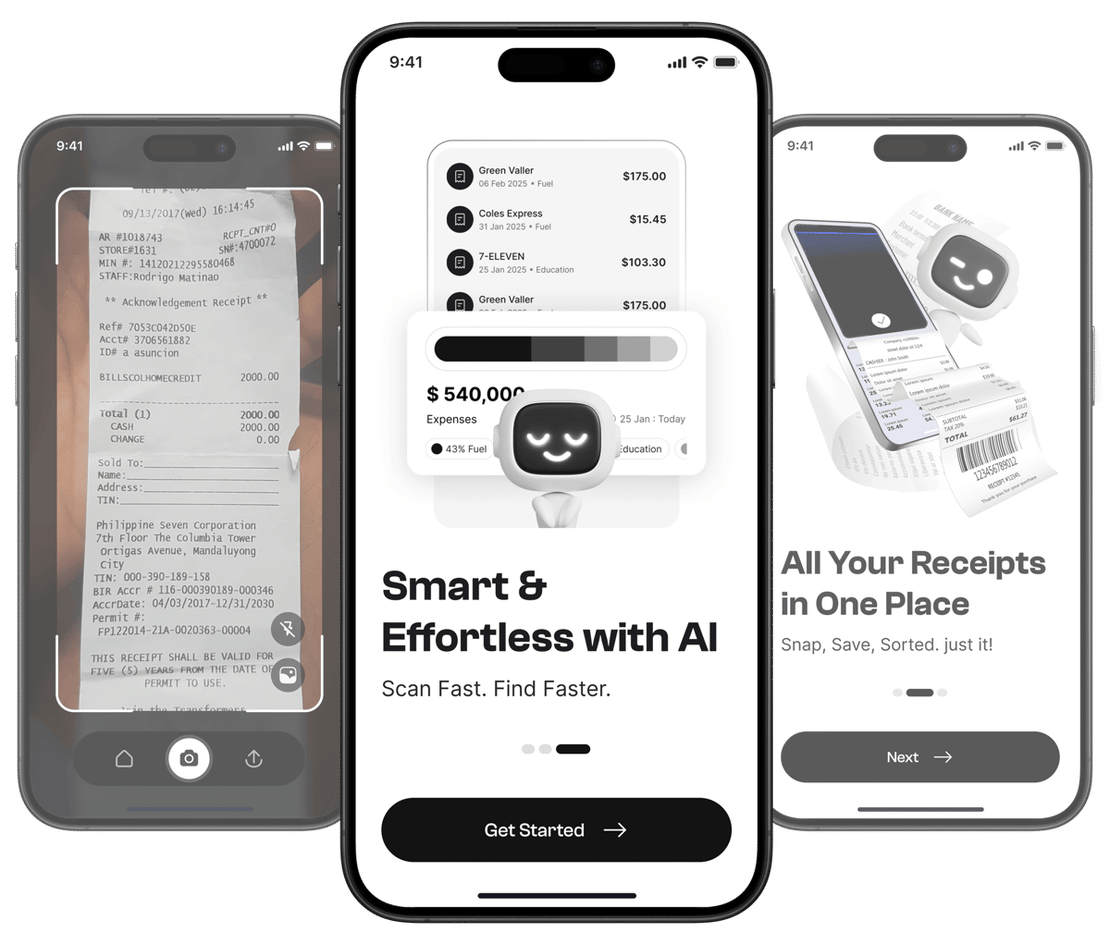
The easiest approach is to scan receipts the moment you get them. Don’t let them pile up on your desk or disappear into your email archive. Having a single, searchable place for all your expense records means you’ll never miss a deduction and you’ll have everything ready when your tax agent asks for it.
Start Claiming What You’re Owed
Between software, hardware, home office costs, and professional development, freelance designers have a substantial range of deductions available. The key is keeping a record of every expense as it happens – not trying to reconstruct a year’s worth of spending in June. Taxr makes it effortless: scan each receipt with your phone, let the AI extract the details and auto-categorise it, and export a clean summary for your tax agent at the end of the financial year. Download Taxr and take the admin out of freelance life.