Tax Deductions for Couriers and Gig Workers Running Multiple Apps
Table of Contents
In short: US couriers and gig workers running several apps report all their income and expenses on one Schedule C, with one combined vehicle or bike total across every app. Deductible costs include the business share of a phone and data plan, insulated bags, and parking and tolls while working. Self-employment tax applies once combined net earnings reach $400, even if no 1099 arrives.
6:45 a.m.: your Amazon Flex block starts at the warehouse. By late morning you've closed it out and flipped the same phone over to Uber Eats for the lunch rush. Mid-afternoon, a TaskRabbit notification pulls you across town for a same-day furniture assembly job. Your phone, which has had three gig apps open and pinging since sunrise, is down to 15% before you've even parked. This is what gig work looks like for a huge number of couriers and taskers: not one job, but three or four running at once, each with its own pay structure and, sometimes, its own small 1099 that shows up in a different envelope every January. Come tax season, the question is less "what do I owe" and more "which platform's income needs what."
Disclaimer: This article provides general information only and does not constitute tax advice. Consult a tax professional, such as a CPA or enrolled agent, about your circumstances.
If you mainly drive for a single platform (you're an Uber driver, full stop, or you only deliver for DoorDash), our guide to tax deductions for rideshare and delivery drivers covers that ground. This one is for the multi-app hustle: stacking Amazon Flex blocks against Uber Eats orders and TaskRabbit jobs in the same week, by car or by bike, because no single platform pays enough on its own.
Deductions for Multi-App Couriers and Taskers
Running several gig apps doesn't have to multiply your paperwork, but it can add to your deductions if you track the right categories. For the fuller list of universal freelancer write-offs (home office, software, insurance), see our 1099 expense tracking guide. The categories specific to multi-app courier work:
- Vehicle or bike costs, combined across every app. Don't track mileage separately for Amazon Flex, then Uber Eats, then TaskRabbit: it's one vehicle (or bike) and one combined business-use total. For a car, choose the standard mileage rate or the actual expense method, and apply it to every mile you worked across all your apps combined. A bike doesn't qualify for the mileage rate, so for a bike you deduct the actual costs.
- Phone and data plan. Your phone is the dispatch center for every app you run, so the business-use share of your bill is deductible. Running three or four apps at once burns through more data and battery than a single-app driver uses, and your business-use percentage should reflect that actual use.
- Insulated bags and delivery equipment. Hot bags, insulated backpacks, and coolers bought to keep food at temperature are ordinary and necessary for the job, so they're fully deductible, regardless of which app the delivery came through.
- Parking and tolls incurred while working. A parking fee while assembling furniture for a TaskRabbit client, or a toll on a delivery route, counts. Parking tickets and other fines never do, no matter which app you were logged into.
- Phone mounts and car chargers. A dash-mounted phone holder and a spare charging cable are standard equipment when your whole workday runs through a phone screen.
- Screen protectors and phone cases. Constant mounting and handling between jobs wears a phone down fast. A replacement screen protector or case bought because of that wear is a legitimate work expense.
- A second phone dedicated to gig work. Some multi-app couriers run a separate device just for gig apps, sparing a personal phone's battery and keeping work logs cleanly separated from personal use.
- Roadside assistance membership. If a breakdown mid-shift means lost income across every app you're running, the work-use share of a AAA-style membership is deductible if you use the actual expense method for your car. With the standard mileage rate you can't deduct it on top of the per-mile rate, though business parking fees and tolls still count.
- Bike safety gear, for bike couriers. A helmet, lights, and a lock are ordinary and necessary equipment for anyone doing this work on two wheels.
Multiple 1099s, One Schedule C
Here's the part that trips up multi-app workers more than almost anything else: even if Amazon Flex, Uber Eats, and TaskRabbit each pay you separately, you are not running three businesses. You're running one (call it "delivery driving" or "gig work"), and every dollar of income and every deduction above goes on a single Schedule C, not three separate ones just because three different companies cut the checks. Add up all your 1099s, add up any gig income that never generated a form, subtract your combined expenses across every platform, and that one net number is what flows to your return.
This is also where a lesser-known rule matters. A platform only has to send you a Form 1099-NEC if it paid you $2,000 or more in the year ($600 for payments made before 2026), so it's entirely possible to run three apps, never cross that line with any single one of them, and receive zero 1099s. That doesn't mean you owe nothing. Self-employment tax (15.3% on the bulk of your net earnings) kicks in once your net self-employment earnings, combined across every app, reach $400 for the year. A courier splitting modest income across three platforms can clear that $400 combined total easily, even with an empty mailbox in January. No 1099 doesn't mean no taxes owed.
Quarterly Estimated Tax Payments
Because none of these platforms withhold anything from your payouts, the IRS doesn't wait until April to collect what you owe. If you expect to owe $1,000 or more for the year across your combined gig income, you're expected to send estimated payments roughly four times a year rather than settling the whole bill in one lump sum at filing time. For the 2026 tax year, the fourth-quarter payment is due January 15, 2027; the other payments fall earlier in the year, spaced unevenly across the calendar. For the exact dates and how the safe harbor rule can protect you from a penalty even if your estimate is a little off, see our quarterly estimated tax guide.
What Doesn't Qualify
Not everything that happens during a shift is deductible. A few things that trip up multi-app couriers specifically:
- Personal errands mixed into a delivery route. Swing by your own grocery store in the middle of a DoorDash route, and the extra miles for that errand don't count; only the work portion of the trip does.
- Parking tickets and traffic fines. These are never deductible, even if you got one while actively working a delivery.
- A phone upgrade you mainly wanted for yourself. If the real reason is wanting a nicer personal device rather than a genuine work need (your current phone already runs the apps fine), that upgrade doesn't belong on Schedule C.
- Personal entertainment apps and subscriptions. Streaming or games on the same phone you use for gig work don't become deductible just because the phone itself is partly a business device.
Record-Keeping
Multi-app work creates a specific record-keeping headache: no single platform sees your whole picture. Amazon Flex doesn't know what you earned on TaskRabbit; Uber Eats doesn't know what you spent on gas that also covered a DoorDash shift. Reconciling several different payout statements against your own mileage and expense log is on you, not any one app.
Keep receipts and records for at least three years. That's the general IRS rule, though it can stretch longer if income turns out to be substantially underreported. The IRS fully accepts digital copies: a clear photo of a receipt taken the moment you get it holds up just as well as the paper original, and it won't fade in a cupholder for six months first.
How Taxr Helps Multi-App Couriers
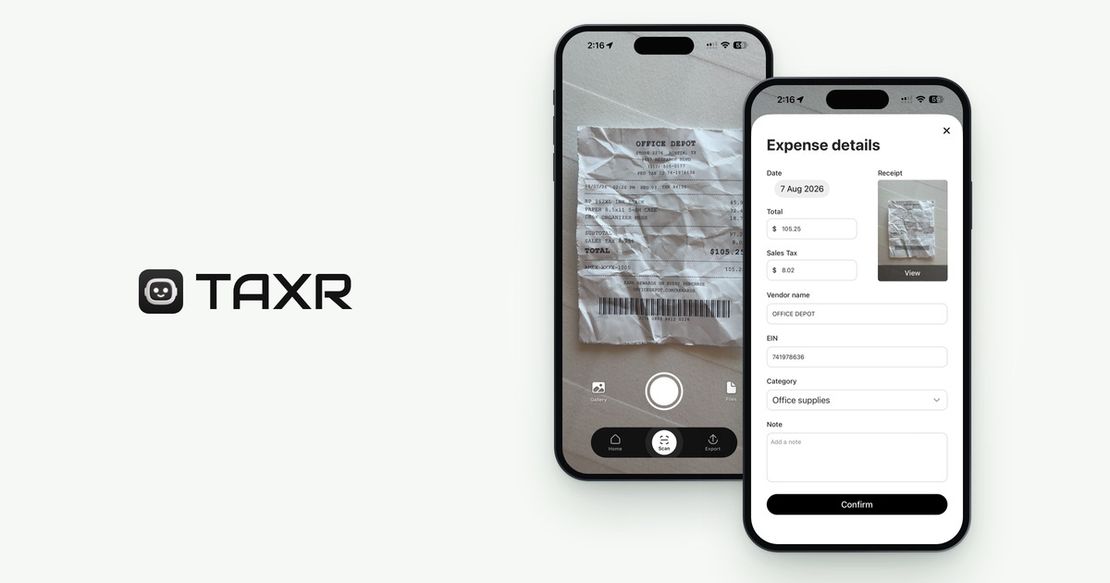
Reconciling four apps' worth of receipts by hand is exactly the kind of task that gets pushed to "later" and then never happens. Taxr fixes that at the point of purchase: scan a receipt (gas, a hot bag, a phone mount from an auto parts store) with your phone camera, and the AI reads the vendor, date, amount, and tax details in seconds, then suggests a Schedule C category, which you confirm. Every receipt is backed up and searchable, so nothing gets lost between an Amazon Flex block and a TaskRabbit job three weeks later.
At tax time, export an Excel or PDF report to work from in your tax software or to send to your tax preparer. Taxr doesn't calculate your tax bill or file anything on your behalf. It keeps the expense side of your return organized and ready to go. For more on how it compares to other options, see our roundup of the best receipt scanner apps.
Running three gig apps instead of one already takes enough juggling. Your receipts shouldn't be one more thing you're trying to keep in the air.