Tax Deductions for Consultants and Freelancers: A 1099 Guide
Table of Contents
In short: US consultants and freelancers paid on a 1099 can deduct a home office ($5 per square foot up to 300 square feet, a maximum of $1,500 a year, under the simplified method), software subscriptions, subcontractors, professional liability insurance and, generally, 50% of business meals. Everyday business attire, the regular commute to a fixed client site and pure entertainment generally don't qualify.
Three client contracts, two invoicing platforms, a growing stack of software subscriptions you signed up for during a free trial and never got around to canceling, and then the first quarterly tax bill lands, and it's bigger than you budgeted for. If you're a consultant or freelancer working on a 1099, this rhythm is familiar: you're good at the actual work, but nobody handed you a manual for what counts as a legitimate business expense and what's just everyday life. Is the coworking membership deductible, or the conference you flew to last spring? The answer is yes more often than freelancers assume, but only if you know where to look and keep the records to back it up.
Disclaimer: This article provides general information only and does not constitute tax advice. Consult a tax professional, such as a CPA or enrolled agent, about your circumstances.
This guide covers the deductions that apply broadly across consulting and freelance work, for business consultants, freelance writers and editors, marketing consultants, coaches, and virtual assistants alike. For a deeper look at 1099 income mechanics like self-employment tax, see our 1099 expense tracking guide. And once you know what qualifies, our companion piece on Schedule C expense categories shows exactly where each deduction lands on your actual tax form.
What You Can Deduct as a Consultant or Freelancer
- Home office. Use part of your home regularly and exclusively for client work, and you can deduct it. The simplified method: $5 per square foot, up to 300 square feet, for a maximum deduction of $1,500 a year. The regular method, based on your actual home expenses, is the alternative, and it can pay off if your dedicated space or housing costs are larger.
- Software and SaaS subscriptions. Project management tools, video call platforms, design or writing software, your CRM, accounting software: anything you pay for to run your business is deductible. It's a category freelancers often under-track, since small recurring charges are easy to stop noticing once a free trial converts to paid.
- Professional development in your field. Courses, certifications, and conferences that sharpen skills you already use are deductible. A marketing consultant taking an analytics certification qualifies; training for an unrelated new career generally doesn't, because the expense has to relate to the business you're already in.
- Subcontractors. Bring in a designer, editor, or fellow consultant to help on client work, and their fee is deductible, but it also flips a familiar form onto you. Pay a subcontractor $2,000 or more in a year (for payments made from 2026; the threshold was $600 before that), and you're the one who has to issue them a 1099-NEC, the same form your own clients send you.
- Professional liability insurance. Errors & omissions (E&O) coverage protects you if a client claims your advice or work caused them financial harm. The premiums are deductible, and for consultants whose advice carries real financial stakes, it's often worth carrying regardless.
- Legal and accounting fees. A lawyer reviewing a client contract, a bookkeeper keeping your books current, or a tax preparer's fee for the business part of your return: all deductible. Knowing what to hand your accountant at tax time turns that handoff into a fast one instead of a stressful one.
- Business meals. Meals with a client, referral partner, or collaborator are generally 50% deductible, provided you document the business purpose and who attended. Pure entertainment (concert tickets, golf, a sporting event) is a different category and generally isn't deductible, even with a client present. If a meal happens alongside it, only the meal follows the 50% rule.
- Travel vs. commuting. Driving from home to a regular, fixed client site you visit routinely works like an ordinary commute and isn't deductible, unless your home office is your principal place of business. But travel between clients, to a temporary work location, or for a business errand during the day generally is.
- Health insurance premiums. If you're self-employed and not eligible for other employer-sponsored coverage, such as through a spouse's job, you can generally deduct premiums for yourself and your family as an adjustment to income. That's valuable because it reduces taxable income even if you don't itemize.
- Retirement contributions. A SEP-IRA and a Solo 401(k) are the two most common retirement accounts for self-employed people, and contributions to either are generally deductible. How much depends on your net self-employment income, and limits change annually, so check irs.gov for the current figures.
What Doesn't Qualify
Not everything that touches your work is deductible, and a few categories trip up freelancers more than any other:
- Everyday business attire. A suit, a blazer, or business-casual clothes you wear to client meetings generally don't qualify, even if you bought them just for work. The test is suitability for ordinary wear, not intent: if you could reasonably wear it outside of work, it doesn't count. A branded uniform or costume is a different story. Our freelancer tax deduction FAQ covers clothing, meals and other common questions.
- The regular commute. Driving to a fixed client site you visit routinely is treated the same as any employee's commute, so it's not deductible however far it is (the exception is when your home office is your principal place of business).
- Pure entertainment. Concert tickets, golf outings, and similar entertainment expenses generally aren't deductible, even with a client along for it.
- Personal subscriptions that only incidentally touch work. A streaming service you occasionally use for "research" or a news subscription you'd have anyway doesn't become a business expense just because it's tangentially useful.
Record-Keeping
The general rule is to keep receipts and records for at least three years from when you file, or longer if you've substantially underreported income. The good news: digital copies are fully accepted. A photo of a receipt taken on your phone holds up just as well as the paper original, so there's no need to hang onto a shoebox of fading thermal paper.
In practice, this is where consultants and freelancers lose the most deductions, and the reason is habit rather than unclear rules. A software subscription that charges your card automatically every month is easy to stop noticing after the first few charges. A client dinner receipt or a parking stub from a day spent moving between two work sites gets shoved in a bag and forgotten by the time the next project starts. None of it is deliberate; it's just what happens when you're focused on the actual work.
Where Taxr Fits In
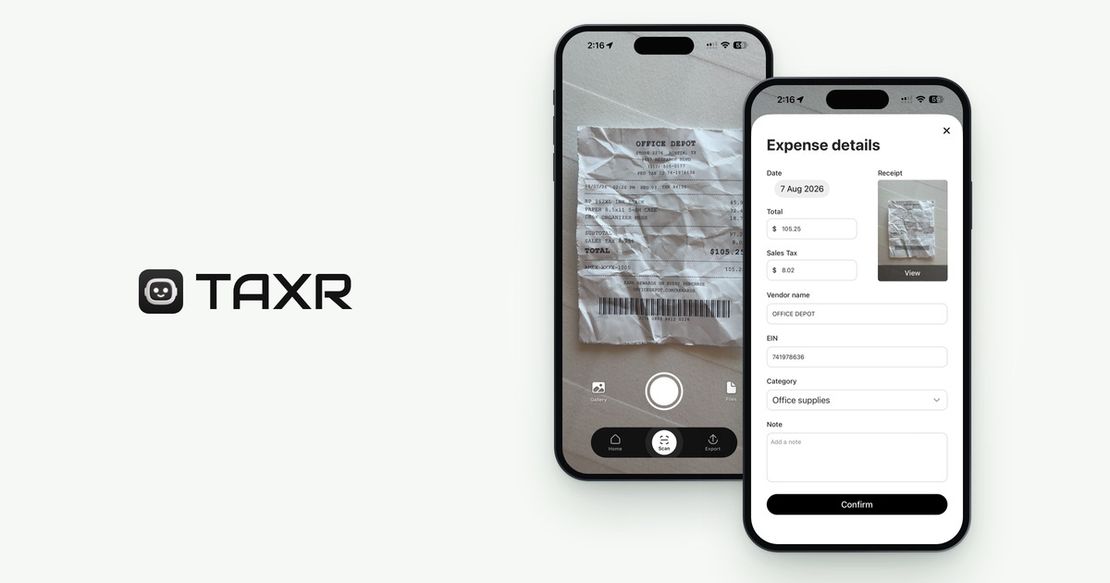
This is exactly the gap Taxr is built to close. Scan a receipt with your phone camera, and the AI extracts the vendor, date, amount, and tax details in seconds, then suggests a Schedule C category, which you confirm. A client dinner, a software renewal, or a subcontractor's invoice lands in the right bucket without a sorting session later. Everything is backed up, and you can export it as an Excel or PDF report to work from in your tax software or to send to your tax preparer.
To be clear: Taxr doesn't file your taxes, it isn't tax software, and it doesn't calculate what you owe. It's a record-keeping tool that makes sure the documentation is there when you need it. If you want to see how it compares to other options, our roundup of the best receipt scanner apps in 2026 breaks down the field.
Consulting and freelancing come with a real tax bill, but also with more legitimate deductions than most people ever get around to claiming. The freelancers who keep the most of what they earn tend to be the ones who keep the paper trail.