17 Tax Deductions Australian Freelancers Miss Every Year
Table of Contents
In short: The ATO lets Australian freelancers deduct expenses directly related to earning their income, provided they have records to prove it. This list of 17 commonly missed deductions covers larger items such as home office running costs, travel between work locations, equipment depreciation and income protection insurance, plus small costs that add up, including software subscriptions, professional memberships and bank fees.
Australian freelancers leave thousands of dollars on the table every tax season. That's rarely down to ignorance: many legitimate tax deductions Australian freelancers miss are small, easy to overlook, or fall into categories people don't realise they can claim. Over a full year, those missed $15 subscriptions, $40 professional memberships, and forgotten bank fees add up to real money.
Disclaimer: This article provides general information only and does not constitute tax advice. Consult a registered tax agent for advice specific to your circumstances.
The ATO allows you to claim deductions for expenses directly related to earning your income, provided you have records to prove it. Here are 17 deductions that freelancers commonly overlook and that could put money back in your pocket.
1. Home Office Expenses
If you work from home, even part-time, you can claim a portion of your household running costs. The ATO's fixed rate method lets you claim 70 cents per hour worked from home (the rate from 1 July 2024), covering electricity, internet, phone, stationery, and computer consumables. Alternatively, the actual cost method lets you calculate the precise work-related percentage of each expense, which can be more valuable if you have a dedicated office space. Our home office deduction calculator compares the two methods using your own hours and costs.
For a deeper look at calculating your home office deduction, see our home office deduction calculator guide.
2. Phone and Internet
If you use the fixed rate method, your phone and internet usage is already included in the hourly rate, so you can't claim it separately. If you use the actual cost method, you can claim the business percentage of both your mobile plan and home internet separately. Keep a diary for a representative four-week period to establish your work-use percentage.
3. Software Subscriptions
Every piece of software you pay for to run your freelance business is deductible. This includes design tools (Adobe Creative Cloud, Figma, Canva Pro), accounting software (Xero, MYOB, QuickBooks), project management platforms (Asana, Notion, Trello), cloud storage (Dropbox, Google Workspace), and communication tools (Slack, Zoom). Check your bank statements: you're likely paying for more subscriptions than you remember.
4. Professional Development
Courses, workshops, webinars, conferences, and certifications that relate to your current work are deductible. This includes online learning platforms like Coursera, Udemy, or LinkedIn Learning when the courses are relevant to your field. Books and industry publications count too. The key requirement from the ATO is that the training must relate to your current income-earning activities, not a completely new field.
5. Travel Between Work Locations
If you travel between two separate workplaces (say from a home office to a client's office, or from one client site to another), that travel is deductible. This is different from commuting to a single regular workplace, which is not deductible. You can claim the ATO's cents-per-kilometre rate (88 cents per km for 2025-26 and 91 cents for 2026-27, up to 5,000 business kilometres) or keep a logbook and claim actual costs. Also deductible: parking fees, tolls, and public transport fares for business travel.
6. Professional Memberships and Associations
Membership fees for professional bodies relevant to your work are deductible. This includes industry associations, professional networks, and organisations like the Australian Institute of Management, the Design Institute of Australia, Engineers Australia, or CPA Australia. If the membership relates to your income-earning activity, you can claim it.
7. Bank Fees and Interest
Account-keeping fees on your business bank account are deductible. If you have a separate business account (which you should), the monthly fees, transaction charges, and merchant fees are all claimable. Interest on loans used for business purposes, such as financing equipment purchases, is also deductible.
8. Accounting Software and Tax Agent Fees
The cost of managing your tax affairs is itself tax-deductible. This covers your accountant's or tax agent's fees for preparing your tax return, any accounting or bookkeeping software you use, and the cost of travel to visit your accountant. Even the portion of Taxr you use for business receipt tracking falls into this category.
9. Income Protection Insurance
Premiums for income protection insurance are generally deductible if the policy pays a regular income stream when you can't work due to illness or injury. This is one of the larger deductions freelancers miss because the premiums are often deducted automatically and forgotten about. Check your bank statements and insurance policies.
10. Public Liability Insurance
If you hold public liability insurance or professional indemnity insurance for your freelance business, the premiums are deductible. Many freelancers working with clients on-site or providing professional advice are required to carry this insurance, but forget to claim it at tax time.
11. Equipment Depreciation
For equipment you use in your freelance business, you generally claim the decline in value (depreciation) over the item's effective life. This includes laptops, monitors, cameras, desks, office chairs, and other equipment. If your business has an aggregated turnover under $10 million, the instant asset write-off may let you deduct the full cost of eligible assets in the year you start using them (check the ATO for the current threshold). The $300 immediate deduction applies to employees and other non-business income, not to business assets. The ATO publishes a schedule of effective life for different asset types. If an item is used for both work and personal purposes, you can only claim the work-related percentage.
12. Stationery and Office Supplies
Pens, notebooks, printer paper, ink cartridges, sticky notes, envelopes and folders are all deductible, but these small purchases are easy to forget. Individually they're minor, but across a year they add up. Get into the habit of scanning every receipt, no matter how small. For tips on building that habit, see our guide to tracking business expenses as a sole trader.
13. Postage and Courier Costs
If you send physical materials to clients (printed proofs, product samples, documents, or equipment), postage and courier fees are deductible. This includes Australia Post costs, courier services, and even the cost of packaging materials.
14. Advertising and Marketing
Anything you spend to promote your freelance business is deductible. This includes paid social media advertising, Google Ads, business card printing, portfolio website hosting, photography for your portfolio, flyers, and promotional materials. If you pay a marketing agency or freelance marketer to help with your brand, those fees are deductible too.
15. Internet Domain Names and Hosting
Your website domain registration, hosting fees, SSL certificates, email hosting (like Google Workspace or Microsoft 365), and any premium themes or plugins you purchase for your business website are all deductible. These are separate from general internet costs and should be claimed individually.
16. Co-working Space Fees
If you rent a desk, hot desk, or dedicated office at a co-working space, those fees are fully deductible as a business expense. This includes casual day passes as well as monthly memberships. Note that if you also claim home office deductions, you need to be careful not to double-claim: you can't claim home office hours for time you spent working at the co-working space.
17. Sunglasses (If Working Outdoors)
This one surprises people, but if your work requires you to be outdoors (construction, landscaping, photography, surveying, market stalls), prescription or protective sunglasses can be deductible. The key is that the sunglasses must be necessary for your work, not just worn for personal comfort. Safety-rated sunglasses for tradies and outdoor workers are the clearest case.
Deduction Guides by Profession
For the deductions that apply to a particular line of work, see the guide for your profession:
- Tax deductions for rideshare drivers
- Tax deductions for freelance graphic designers
- Tax deductions for tradies
- Tax deductions for IT contractors
- Tax deductions for real estate agents
- Tax deductions for nurses and healthcare workers
- Tax deductions for teachers
- Tax deductions for freelance photographers
- Tax deductions for personal trainers
- Tax deductions for musicians and artists
- Tax deductions for content creators and YouTubers
- Tax deductions for cleaners
How to Make Sure You Never Miss a Deduction Again
The common thread across all 17 of these missed deductions is simple: people forget to track them. One change to know about for the 2026-27 year is the new $1,000 instant tax deduction for work-related expenses. It applies to salary and wage income only, not business income, so it doesn't replace any of the business deductions above. If you also earn a wage, the guide explains how it works. A $12 monthly software subscription doesn't feel significant in January, but by December it's $144 you're entitled to claim. Multiply that across a dozen small expenses and you're looking at real money.
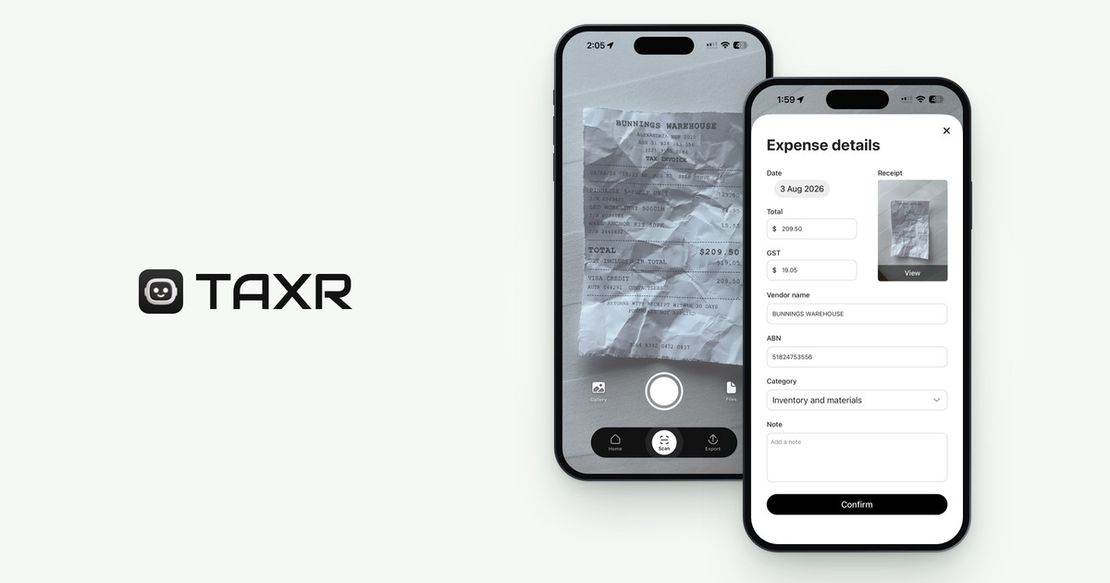
The fix is to capture every expense as it happens. With Taxr, you scan any receipt with your phone's camera, and the AI extracts the date, amount, vendor, and GST automatically. It suggests a category for each expense for you to confirm, and every expense is stored securely and ready to export to your accountant at tax time. No more digging through bank statements or guessing what that $49.99 charge was for.
For a breakdown of how to set up your expense categories, see our freelancer expense categories guide.
Start tracking today, and next financial year you won't leave a single dollar on the table.