Lost a Receipt? What the ATO Accepts When You Lodge Your Own Tax Return
Table of Contents
A lost receipt doesn't always mean a lost deduction. On your 2025-26 tax return you can claim some work-related expenses without receipts, within set limits, and the ATO can accept other evidence in place of a missing receipt, such as a supplier's copy or a bank statement backed by something that shows what you bought. What you can't do is claim an amount you have no way of supporting: if the ATO reviews your return and the evidence isn't there, it can remove the deduction.
Disclaimer: This article provides general information only and does not constitute tax advice. Consult a registered tax agent for advice specific to your circumstances.
What the ATO Expects You to Have
The starting point is written evidence. For work-related expenses, the ATO's guidance on records you need to keep asks for a receipt or invoice from the supplier that shows:
- the supplier's name
- the amount
- what the goods or services were
- the date of the expense
- the date of the document
Those five points come from Division 900 of the Income Tax Assessment Act 1997, which allows two fixes. If the receipt doesn't say what you bought, you can write that on it yourself before you lodge. If it doesn't show the date of the expense, a bank statement can show when you paid.
You keep receipts, generally for five years from the date you lodge, and if the ATO reviews the return and you can't support a claim, the claim can be taken off.
What You Can Claim Without a Receipt in 2025-26
The first two exceptions apply only to work-related expenses, meaning the costs of earning salary or wages. They don't apply to a sole trader's business expenses.
- Work-related claims of $300 or less in total. You don't need receipts, but you must have spent the money and be able to show how you worked out the amount. If your work-related claims add up to more than $300, you need written evidence for all of them, including the first $300. Car expenses and allowance-covered meal and travel costs sit outside the limit, with their own rules.
- Laundry claims of $150 or less. For washing, drying and ironing work clothing (not dry-cleaning), you don't need receipts, even when your other work claims take you over $300, but keep a note of how you worked the amount out. The $150 counts towards the $300 and doesn't raise it to $450.
- Small expenses of $10 or less. If you couldn't get a receipt, your own note can serve as the written evidence, for up to $200 of these expenses in a year. The note needs the same details as a receipt and must be made as soon as possible after the expense, so a list written from memory months later is unlikely to qualify.
- Receipts that were unreasonable to get. Where the ATO accepts that you couldn't reasonably have got a receipt, the same kind of note works, for any amount, and it doesn't count towards the $200.
This is the last return for the $300 and $150 limits. The Treasury Laws Amendment (Tax Reform No. 1) Act 2026 repealed both from the 2026-27 income year, when the $1,000 standard deduction for work-related expenses begins. From then, the ATO's guidance on the standard deduction says anyone claiming more than $1,000 of work-related expenses needs records for all of them. The small-expense and hard-to-get rules remain.
When the Receipt Is Gone: What Can Stand In
Work down this list for each missing receipt:
- A copy you already have. A photo, a scan or an emailed receipt will do. The ATO accepts electronic copies, including photos, if each is a true and clear copy of the original, and the Act treats a complete copy of a lost document as the original.
- A replacement from the supplier. Ask for a duplicate receipt or a copy of the invoice. There's no time limit for getting written evidence, so a document issued now still counts. If it's on its way when you lodge, you can claim the expense as long as you have good reason to expect it within a reasonable time. If it never arrives, the deduction falls away.
- A statement plus something that shows what you bought. Where you couldn't get a receipt, the ATO may accept a bank or card statement showing the amount, the date and who was paid, together with another document that describes the goods or services, or a record in your work diary. The statement isn't enough alone.
- No document of any kind. If you paid cash and have nothing else, the ATO says you won't have enough evidence to claim.
If records were stolen, destroyed in a disaster, or lost when you had to leave home suddenly, the ATO's guidance on lost or destroyed records says it can allow the deduction on other evidence, provided you took reasonable precautions, can't reasonably get substitutes and can show the loss happened. Not knowing the rules isn't a ground for relief: the ATO's own example is someone who assumed receipts were only needed above $300.
These are discretions, not entitlements: claim only an expense you really incurred and can evidence.
If You're a Sole Trader
The $300 and $150 exceptions cover the costs of earning salary or wages, so they don't apply to the business expenses of a sole trader. If you have a job and a business, they apply only to the job's expenses.
For the business, section 262A of the Income Tax Assessment Act 1936 requires records that record and explain every transaction relevant to your tax, generally kept for five years from when the record was prepared or obtained, or the transaction was completed, whichever is later. There's no $300 threshold: the ATO's record-keeping rules for business apply to a business expense whatever its size. Car and overnight travel claims have written-evidence rules of their own, covered in our guide to vehicle and travel deductions.
Digital copies are accepted. The ATO's guidance on paper records says that once you have saved a true and clear image of a paper record you don't have to keep the paper, and that copying EFTPOS receipts is good practice because the details can fade.
Scan What You Have Before You Lodge
Receipts printed on thermal paper can fade, and a receipt you can't read is no better than a lost one. Before you lodge:
- Collect everything: wallet, car, bags, drawers, and the inboxes where emailed receipts land.
- Photograph or scan each paper receipt while it's still legible, and check that the supplier, date, amount and description are readable in the image.
- Write on the receipt what it was for if it doesn't say, and note how the expense relates to your work.
- List what's missing and work through the options above. Claim only what you can back with evidence.
The 2026 Deadline
Returns you lodge yourself are due by 31 October. In 2026 that date is a Saturday, and the ATO says that when 31 October falls on a weekend the due date is the next business day, which is Monday 2 November 2026. A missing receipt isn't a reason to lodge late. Our 31 October deadline guide covers the tax agent option and what happens if you miss the date.
How Taxr Helps
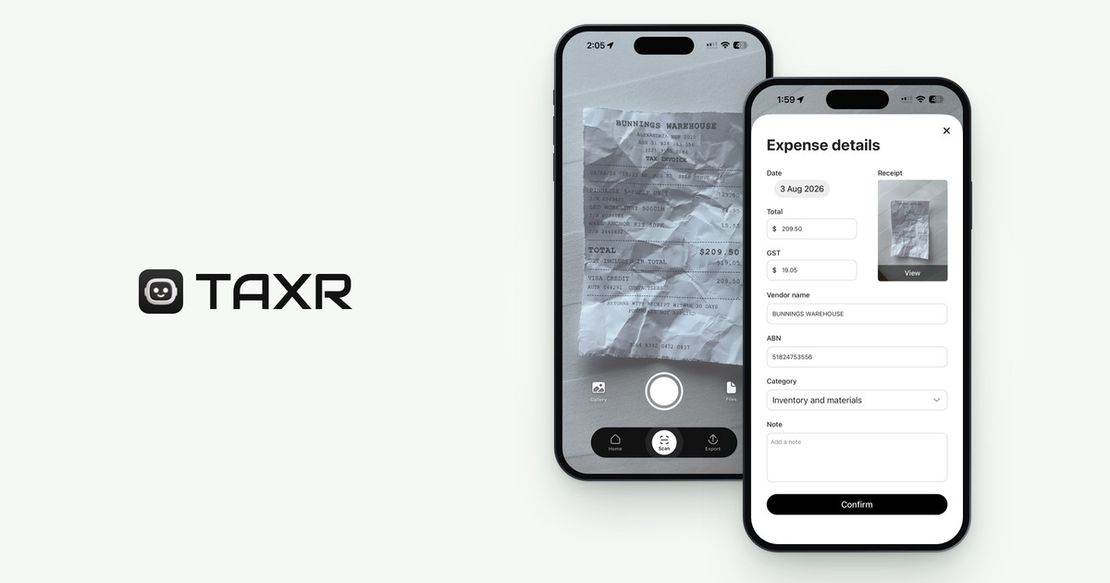
Taxr is a receipt scanner app for iPhone, iPad and Android. Photograph a paper receipt, choose a photo from your gallery or import a PDF, and in about 5 seconds the AI reads the vendor, date, total and GST and suggests a category for you to confirm. The image stays with the record in your account, so it's still readable after the paper has faded.
At tax time, export an Excel or PDF report for the financial year. The PDF is a summary by category with a table of every receipt. The Excel file has a link to each receipt image, and those links expire 48 hours after the export. Taxr is free to start, and our guide to scanning and storing receipts has the full method.
Frequently Asked Questions
Can I claim a tax deduction without a receipt?
Yes, in limited cases. On a 2025-26 return, if your work-related claims total $300 or less you don't need receipts, provided you spent the money and can show how you worked out the amount. Above $300 you need written evidence for all of them, or other evidence the ATO accepts in its place.
Is a bank statement enough proof for the ATO?
No, not on its own. The ATO says a bank or credit card statement isn't written evidence because it doesn't come from the supplier and generally doesn't show what was bought. It can help when you add a document that describes the purchase, or a note in your work diary.
Does the ATO accept photos of receipts?
Yes. The ATO says you can keep records on paper or electronically, including photos, as long as each copy is a true and clear copy of the original. It recommends backing up electronic records.
Does the $300 rule apply to sole traders?
No, not to business expenses. The $300 exception covers work-related expenses, which are the costs of earning salary or wages. Business expenses come under the business record-keeping rule, which requires a record of every transaction, kept for five years.
Start With the Receipts You Still Have
Scan receipts as you get them, and next October's return starts with the evidence already in order. Download Taxr free and scan the receipts you still have before you lodge.