International Freelancer Tax Guide: Managing Expenses Across AU, UK, and US
Table of Contents
In short: Freelancers working across Australia, the UK and the US pay tax primarily where they are tax resident, not where their clients are. For expenses, keep records by each country's tax year (1 July to 30 June in Australia, 6 April to 5 April in the UK, 1 January to 31 December in the US) and convert foreign amounts at the exchange rate on the transaction date.
The rise of remote work has made international freelancing more accessible than ever. You might be an Australian designer picking up clients in London, a British copywriter billing a New York agency, or a US-based developer contracting for a Melbourne startup. The work itself is borderless. The tax obligations are anything but. If you're managing expenses across Australia, the UK, and the US, you need to understand how each country's tax system works, where your obligations lie, and how to track expenses without drowning in complexity.
Disclaimer: This article provides general information only and does not constitute tax advice. Consult a qualified tax professional about your circumstances.
This guide breaks down the key differences across all three jurisdictions and offers practical strategies for staying on top of multi-country expense tracking.
Tax Residency: Where You Pay Tax
The single most important concept for international freelancers is tax residency. Where you pay tax depends primarily on where you are a tax resident, not where your clients are located.
- Australia: The ATO determines tax residency based on where you ordinarily reside, your domicile, and the length of time you've been in Australia. If you're an Australian tax resident, you're taxed on your worldwide income, including income earned from overseas clients.
- UK: HMRC uses the Statutory Residence Test (SRT), which considers how many days you spend in the UK, your ties to the country, and whether you have a home here. UK tax residents pay tax on worldwide income.
- US: The IRS taxes based on citizenship and residency. US citizens and permanent residents (green card holders) are taxed on worldwide income regardless of where they live. Non-residents are taxed only on US-source income.
The practical implication: if you're an Australian freelancer working from your home office in Sydney for a client in London, you pay Australian tax on that income. You report it to the ATO like any other business income. Where things get complicated is when you physically work in multiple countries, hold dual citizenship, or spend extended periods abroad. In those cases, you may have tax obligations in more than one jurisdiction.
Key Differences Across AU, UK, and US
Understanding the structural differences between these three tax systems is essential for managing multi-country freelance income.
Consumption Taxes: GST, VAT, and Sales Tax
- Australia: The Goods and Services Tax (GST) is 10%, and you must register once your annual turnover reaches $75,000. Once registered, you charge GST on your services, claim GST credits on business purchases, and lodge quarterly Business Activity Statements (BAS).
- UK: Value Added Tax (VAT) is 20% (standard rate), with registration required at £90,000 turnover. VAT-registered businesses charge VAT on invoices, reclaim VAT on business expenses, and file VAT returns quarterly.
- US: There is no federal VAT or GST. Sales tax is handled at the state level and generally applies to goods, not services. Most freelancers providing services don't need to collect sales tax, but the rules vary by state and service type.
Financial Year Dates
- Australia: 1 July to 30 June
- UK: 6 April to 5 April
- US: 1 January to 31 December
If you're working across multiple countries, you may be dealing with three different fiscal years simultaneously. An expense incurred in February falls in different tax years depending on which country you're reporting to.
Filing Deadlines
- Australia: 31 October (or later if using a registered tax agent, often as late as 15 May the following year)
- UK: 31 January for online Self Assessment filing. See our UK Self Assessment deadline guide for full details.
- US: 15 April for individual returns, with quarterly estimated payments due throughout the year. For more on US freelancer obligations, see our 1099 expense tracking guide.
Deduction Categories
While all three countries allow freelancers to deduct ordinary and necessary business expenses, the categories and rules differ:
- Home office: Australia uses the revised fixed-rate method (70 cents per hour for 2024-25 and 2025-26) or actual cost method. The UK offers simplified expenses (a flat £10, £18 or £26 a month, depending on whether you work 25 to 50, 51 to 100, or 101 or more hours a month at home) or actual proportional costs. The US offers the simplified method ($5/sq ft, up to 300 sq ft) or actual expense method.
- Vehicle: Australia allows the cents-per-kilometre method (88 cents/km for 2025-26 and 91 cents/km for 2026-27, up to 5,000 km) or logbook method. The UK uses approved mileage rates (45p/mile for the first 10,000 miles, then 25p). The US uses the standard mileage rate or actual expenses.
- Meals: Australia allows deductions for meals while travelling for business. The UK is more restrictive: meals are only deductible if you're travelling away from your normal place of work. The US allows 50% of business meal costs with documentation requirements.
Double Taxation Agreements
If you do end up with tax obligations in more than one country, double taxation agreements (DTAs) exist to prevent you from paying full tax on the same income twice. Australia has DTAs with both the UK and the US, and the UK has one with the US.
These agreements typically work through tax credits (you pay tax in one country and claim a credit in the other) or exemptions (certain income is taxed only in one country under the treaty). For most freelancers, the practical application is straightforward: you pay tax in your country of residence and claim a foreign tax credit if tax was withheld at the source. If your situation involves significant cross-border income, work with an accountant who specializes in international tax.
Expense Tracking Challenges for Multi-Country Freelancers
Managing expenses across multiple jurisdictions introduces several layers of complexity that domestic-only freelancers don't face:
Different currencies. When you invoice a UK client in pounds and pay for software in US dollars while reporting to the ATO in Australian dollars, every transaction needs to be converted. The exchange rate on the date of the transaction is what matters for tax purposes, not the rate when you reconcile your books.
Different categorization requirements. The categories the ATO uses on your tax return don't map neatly to HMRC's Self Assessment categories or the IRS Schedule C categories. An expense labeled "professional development" in Australia might fall under "training" in the UK and "education" in the US. If you're reporting in multiple jurisdictions, you need your records structured for each.
Different fiscal years. A subscription payment in March falls into different tax years depending on which country you're reporting in. You can't just run a single annual report. You need to slice your expenses by the correct date ranges for each jurisdiction.
Different receipt requirements. The ATO, HMRC, and IRS all require you to keep receipts, but the retention periods differ. The ATO requires records for five years from the date you lodge your return. HMRC requires self-employed people to keep records for at least five years after the 31 January filing deadline for that tax year. The IRS generally requires three years, or six if you leave out more than 25% of your gross income. You also need to document the exchange rate used for each transaction, as any of these tax offices may request it during an audit.
How Taxr Handles Multi-Country Freelancing
Taxr is localized for 195+ countries, and a few of its features help when your work crosses borders.
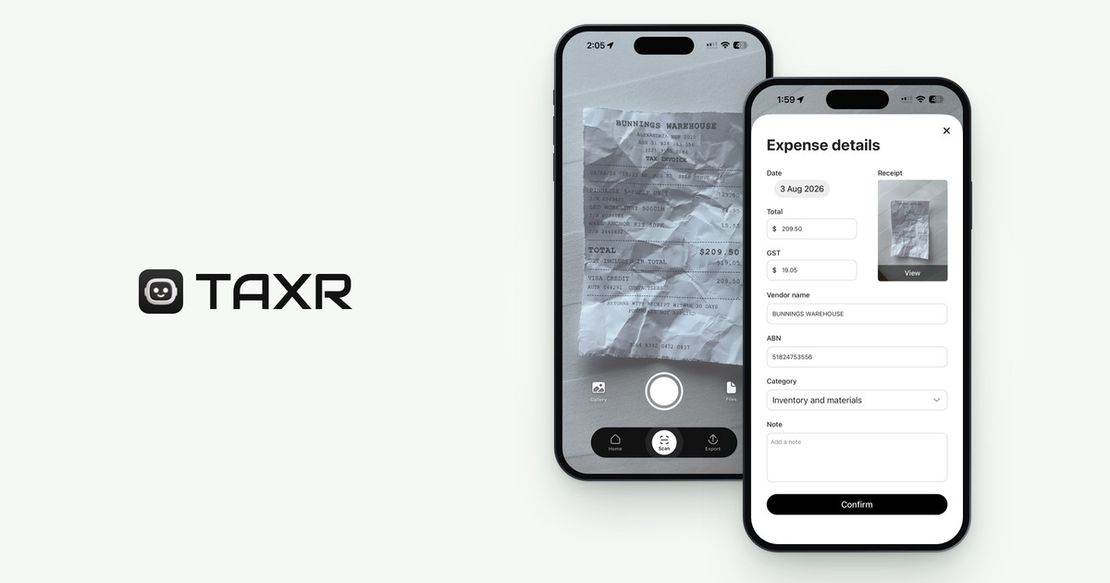
AU GST, UK VAT, and US Sales Tax support in one app. When you scan a receipt, Taxr extracts the tax component automatically, whether it's GST, VAT, or Sales Tax. The app sets its tax label, currency and expense categories to match the country you choose, so the same app works for filing in Australia, the UK or the US.
Receipts in other currencies. Your country setting decides the currency your records are kept in. The AI reads the amount and tax as printed, so a receipt from a London taxi, a Sydney office supply store or a US SaaS subscription still scans, but it doesn't convert currencies. For a receipt in another currency, change the total and tax to your home currency before you save, using the exchange rate for the date of the purchase.
Export any date range, by category. When it's time to file, export your expenses for the exact fiscal year you need: 1 July to 30 June for the ATO, 6 April to 5 April for HMRC, or 1 January to 31 December for the IRS. The Excel or PDF report totals your expenses by category and is emailed to you or your accountant.
For more on how Taxr supports Australian GST tracking specifically, see our GST receipt tracking guide. And if you're navigating the UK's Making Tax Digital requirements, our MTD guide for self-employed covers what you need to know.
Stay on Top of Multi-Country Tax
International freelancing is rewarding, but the tax complexity is real. The freelancers who manage it successfully are the ones who track every expense as it happens, understand which jurisdiction it applies to, and have their records organized long before any deadline arrives.
Don't wait until you're staring down three different filing deadlines with a pile of foreign-currency receipts. Download Taxr and start capturing every expense, in every country you work in, from the moment you incur it.