Home Office Deduction Calculator: How to Claim in Australia
Table of Contents
In short: If you regularly work from home in Australia, the ATO offers two ways to claim a home office deduction. The fixed rate method allows 70 cents per hour worked from home for 2024-25 and 2025-26, plus equipment depreciation, and needs a record of your actual hours. The actual cost method claims the work-related share of running costs and needs more records, but can give a larger deduction.
If you work from home, either full-time as a freelancer or a few days a week as a remote employee, you're likely entitled to claim a home office deduction in Australia. The question is how much, and which calculation method gives you the best result. This home office deduction calculator guide walks you through both methods with real numbers so you can work out which one puts more money back in your pocket.
Disclaimer: This article provides general information only and does not constitute tax advice. Consult a registered tax agent for advice specific to your circumstances.
Who Can Claim Home Office Deductions?
Before calculating anything, you need to confirm you're eligible. The ATO allows home office deductions if you meet these conditions:
- You work from home regularly: occasional after-hours emails don't count. You need to be genuinely performing work duties from home, not just checking messages.
- You have a dedicated work area or use a shared space for work purposes: this can be a separate room used as an office, or a corner of your dining table where you set up your laptop. A dedicated room gives you access to more claims under the actual cost method, but it's not mandatory.
- You incur additional expenses as a result of working from home, such as higher electricity bills, internet usage, or phone costs.
Both employees and self-employed individuals can claim, but the rules differ slightly. Employees can only claim expenses they pay for themselves (not reimbursed by their employer). Sole traders and freelancers can claim any legitimate business expense related to working from home.
The Fixed Rate Method Explained
The fixed rate method is the simpler of the two options. For 2024-25 and 2025-26, the ATO's rate is 70 cents per hour worked from home.
What the 70 cents covers
The fixed rate is designed to cover a bundle of running expenses:
- Electricity and gas for heating, cooling, and lighting
- Internet and data
- Phone usage
- Stationery and computer consumables (ink, paper, USB drives)
What it does NOT cover
The fixed rate does not include:
- Depreciation of equipment: items like desks, chairs, monitors, and computers must be claimed separately
- Furniture purchases: an office chair or standing desk is a separate deduction
- Repairs to your office furniture and equipment: if you fix or maintain them, that's a separate claim
This is an important distinction. You can use the fixed rate for running costs and still claim the work-related portion of equipment depreciation on top.
What records you need
To use the fixed rate method, you must keep a record of the actual hours you work from home, such as a timesheet, roster, diary, or time-tracking app. The ATO expects contemporaneous records, meaning you record the hours as they happen, not from memory at the end of the year. You also need at least one record, such as a bill or receipt, for each running expense the rate covers.
Calculation example
A freelance graphic designer works from home five days a week, averaging 7.5 hours per day, for 48 weeks of the year:
- Hours per week: 37.5
- Weeks worked: 48
- Total hours: 1,800
- Deduction: 1,800 x $0.70 = $1,260.00
She can then separately claim the depreciation on her $2,400 monitor (effective life of 4 years = $600 per year) and her $800 desk chair (effective life of 10 years = $80 per year), bringing her total home office claim to $1,940.00.
The Actual Cost Method Explained
The actual cost method requires more record-keeping but can deliver a larger deduction, especially if you have a dedicated home office.
With this method, you calculate the actual proportion of each household expense that relates to your work. The key factor is your dedicated work area as a percentage of the total floor area of your home.
How to calculate it
- Measure your work area: for example, your home office is 12 square metres
- Measure the total floor area: your home is 90 square metres
- Calculate the percentage: 12 / 90 = 13.3%
- Apply that percentage to relevant household running costs
Worked example: electricity
- Annual electricity bill: $2,400
- Home office percentage: 13.3%
- Work-related electricity: $2,400 x 0.133 = $319.20
But that's just electricity. You also claim the work-related portion of:
- Internet: if you use the internet 60% for work, and your annual plan costs $1,200, you claim $720
- Phone: if 50% of your phone use is work-related and your annual cost is $720, you claim $360
- Furniture depreciation: a $1,500 desk with a 20-year effective life = $75/year, fully deductible if used exclusively for work
- Equipment depreciation: a $2,000 laptop with a 2-year effective life = $1,000/year at 100% work use
Full actual cost example
| Expense | Annual Cost | Work % | Deduction |
|---|---|---|---|
| Electricity | $2,400 | 13.3% | $319.20 |
| Internet | $1,200 | 60% | $720.00 |
| Phone | $720 | 50% | $360.00 |
| Desk depreciation | $1,500 | 20-year life | $75.00 |
| Chair depreciation | $800 | 10-year life | $80.00 |
| Monitor depreciation | $2,400 | 4-year life | $600.00 |
| Laptop depreciation | $2,000 | 2-year life | $1,000.00 |
| Total | $3,154.20 |
Before depreciation, that's $1,399.20 of running costs, compared with $1,260 under the fixed rate method in this scenario.
Which Method Gives You a Bigger Home Office Deduction?
Let's compare the two methods side by side for our freelance graphic designer who works 37.5 hours a week from a dedicated home office.
Fixed rate method
- 1,800 hours x $0.70 = $1,260.00
- Plus equipment/furniture depreciation: $1,755.00
- Total: $3,015.00
Actual cost method
- Running costs (electricity, internet, phone): $1,399.20
- Plus equipment/furniture depreciation: $1,755.00
- Total: $3,154.20
Difference: $139.20 more with the actual cost method.
When fixed rate wins
The fixed rate method tends to be the better choice if:
- You don't have a dedicated office room (you work from the kitchen table or a shared space)
- Your utility bills are low
- You work from home part-time or irregularly
- You want simplicity and minimal record-keeping
When actual cost wins
The actual cost method typically delivers a larger deduction if:
- You have a dedicated room used exclusively (or primarily) as an office
- Your utility costs are above average
- You've purchased significant equipment or furniture for your home office
- You work from home full-time
For many full-time freelancers with a dedicated home office, the actual cost method is worth the extra record-keeping effort. Even an extra hundred dollars or so in deductions each year adds up over time. To compare the two methods with your own hours and costs, try our home office deduction calculator.
What Records You Need to Keep
The record-keeping requirements differ depending on which method you choose.
Fixed rate method records
- Hours worked from home: a diary, timesheet, roster, or digital record showing the actual hours you worked from home throughout the year. This must be a contemporaneous record, not a year-end estimate.
- One record for each running expense the rate covers: for example, one quarterly electricity bill and one phone bill, to show you incurred those costs.
Actual cost method records
- All utility bills: electricity, gas, internet, and phone bills for the entire year
- Receipts for equipment and furniture: invoices for any desks, chairs, monitors, computers, or other items you're depreciating
- Floor plan or measurements: documentation showing the size of your work area relative to your total home
- A diary of work hours: similar to the fixed rate method, you need to show when you worked from home
Both methods
Regardless of which method you use, you must keep your records for five years from the date you lodge the tax return they relate to. Digital copies are fine: the ATO accepts photos and scans of receipts as valid evidence.
For more strategies on reducing your tax bill, read our 5 tax deduction tips every freelancer should know. And if you work in a creative field, our guide to tax deductions for graphic designers and freelancers covers industry-specific claims you might be missing.
Track Home Office Expenses with Taxr
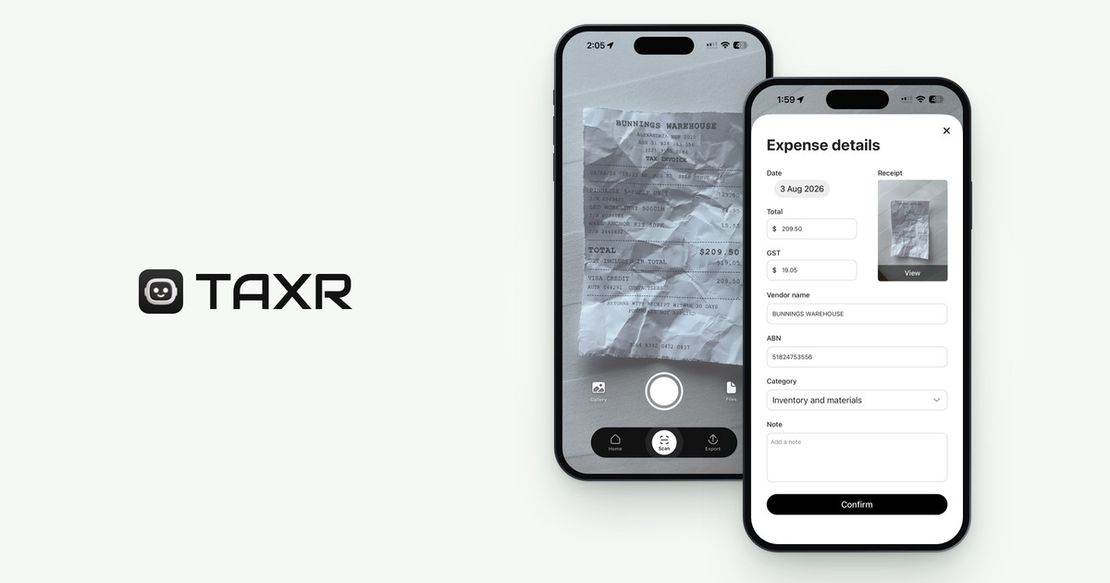
Whichever method you choose, you need receipts for equipment and furniture purchases. Taxr makes it simple: scan the receipt for your new monitor, desk, or office chair, and Taxr reads it and suggests a category (equipment, for example) for you to confirm. When tax time arrives, export an Excel or PDF summary showing each purchase with its date, amount and GST, ready to hand to your tax agent or use for your return.
Calculate Your Home Office Deduction Today
Don't leave money on the table. With either the fixed rate or the actual cost method, claiming your home office deduction can save you hundreds or thousands of dollars each year. Gather your records, run the numbers for both methods, and pick the one that gives you the bigger result. Download Taxr to keep your home office receipts organised and your deduction claims well documented.