Freelancer Expense Categories Explained: A Simple Breakdown
- Taxr Team
- Business finance
- March 30, 2026
Table of Contents
Understanding freelancer expense categories is one of those things that seems straightforward until you actually sit down with a pile of receipts and try to sort them. Does that new monitor go under “Office Equipment” or “Computer Expenses”? Is your Canva subscription “Software” or “Marketing”? And what about that coffee you bought while meeting a client? Getting your categories right matters – it affects your tax return, your BAS, and how clearly you understand where your money is actually going.
Disclaimer: This article provides general information only and does not constitute tax advice. Consult a registered tax agent for advice specific to your circumstances.
Why Freelancer Expense Categories Matter for Tax
The ATO expects you to keep organised records of all your business expenses. When you lodge your tax return, deductions need to be reported under the correct categories. Getting this wrong can mean claiming less than you’re entitled to, or worse, triggering an audit because your claims don’t match what the ATO expects for your industry.
Correct categorisation also makes your BAS faster to prepare. If your expenses are already sorted into the right buckets, pulling together your quarterly GST figures takes minutes instead of hours. And when your accountant opens your records at tax time, clean categories mean less back-and-forth and lower accounting fees.
In short: the time you spend categorising properly throughout the year saves you far more time (and money) at the end of it.
Common Expense Categories for Freelancers
Here are the categories most freelancers will use regularly, along with real examples to help you sort your own expenses.
Office Supplies and Equipment
This covers physical items you buy for your workspace or business operations.
- Desk, chair, monitor, keyboard, and mouse
- Printer ink, paper, notebooks, and pens
- External hard drives and USB cables
- Desk lamp, filing cabinet, or whiteboard
Items over $300 may need to be depreciated rather than claimed in full in the year of purchase. Check the ATO’s depreciation rules for current thresholds.
Software and Subscriptions
Any software or online service you use for your business counts here.
- Adobe Creative Cloud, Figma, or Sketch
- Accounting software like Xero, MYOB, or QuickBooks
- Project management tools like Asana, Notion, or Trello
- Cloud storage services like Google Workspace or Dropbox
If you use a subscription for both personal and business purposes, you can only claim the work-related portion.
Travel and Transport
Business travel – not your daily commute to a regular workplace – can be claimed.
- Flights, trains, and buses for client meetings or site visits
- Uber or taxi fares for business trips
- Accommodation for overnight business travel
- Meals during overnight business travel (reasonable amounts only)
The ATO has specific rules about what counts as business travel versus commuting. If you work from home and travel to a client’s office, that’s generally claimable. If you go to the same office every day, it’s commuting.
Home Office
If you work from home regularly, a portion of your household running costs is deductible.
- Electricity and gas (work-related portion)
- Internet connection (work-related portion)
- Home office furniture and equipment
- Cleaning costs for a dedicated home office
The ATO’s fixed rate method allows you to claim 67 cents per hour worked from home, which covers most running costs. Alternatively, the actual cost method lets you calculate the real proportion, which can yield a larger claim if you have a dedicated workspace.
Professional Development
Upskilling that relates to your current work is deductible.
- Online courses on platforms like Coursera, Udemy, or LinkedIn Learning
- Conference and seminar registration fees
- Industry certifications and exam fees
- Books, journals, and professional publications related to your field
The key requirement is that the training must relate to your current income-earning activity. A graphic designer can claim a UX design course, but probably can’t claim a cooking class – unless they design for restaurants and can demonstrate a direct connection.
Marketing and Advertising
Expenses related to promoting your business or finding new clients fall here.
- Website hosting, domain registration, and maintenance
- Google Ads, Facebook Ads, or Instagram promotion
- Business cards, brochures, and printed materials
- Portfolio website platforms like Squarespace or WordPress
Insurance
Business-related insurance premiums are deductible.
- Professional indemnity insurance
- Public liability insurance
- Income protection insurance (may be partially deductible)
- Equipment and contents insurance for your home office
Communication
Phone and internet costs used for business purposes can be claimed.
- Mobile phone plan (work-related portion)
- Landline charges for business calls
- Internet service (work-related portion, if not already covered by home office method)
- VoIP services or virtual phone numbers
If you use your personal phone for work, you need to calculate the business-use percentage. The ATO accepts a four-week representative diary as evidence of your usage pattern.
Professional Services
Fees you pay to other professionals for business-related services are deductible.
- Accountant and tax agent fees
- Legal advice related to your business
- Bookkeeping services
- Business consulting or coaching
ATO Work-Related Expense Categories
It’s worth noting that the ATO groups expenses differently from most accounting software. The ATO’s deductions you can claim page organises things by type – clothing, education, travel, working from home – rather than by traditional accounting categories.
This means your accounting software might use categories like “Office Supplies” and “Professional Development,” while the ATO groups them under broader headings in your tax return. Your accountant handles this mapping at tax time, but using consistent, well-defined categories throughout the year makes their job much easier.
If you’re lodging your own return through myTax, understanding how the ATO structures deductions helps you place each expense in the right section. For advice specific to your situation, check with your registered tax agent.
How to Handle Expenses That Fit Multiple Categories
This is one of the most common headaches in expense tracking. Your Canva subscription could be “Software” or “Marketing.” A Zoom Pro plan could be “Software” or “Communication.” Here’s how to handle it:
Pick the most specific category. If the expense has a clear primary purpose, go with that. Canva is primarily a design tool, so “Software & Subscriptions” makes more sense than “Marketing” – unless you only use it for creating ads.
Be consistent. Whatever you decide, stick with it. If you categorise Zoom as “Communication” in July, don’t switch it to “Software” in September. Consistency makes your records cleaner and easier for your accountant to review.
Document your reasoning. If a categorisation choice isn’t obvious, make a note of why you chose a particular category. This is especially useful if the ATO ever asks about a specific deduction – you can show that you made a considered, reasonable decision.
Don’t stress about perfection. The ATO cares that you’re claiming legitimate business expenses with proper records. As long as you’re consistent and can justify your choices, the exact category matters less than having the receipt and a clear business purpose.
Auto-Categorisation with AI
Manually sorting every receipt into the right category is one of the most time-consuming parts of expense tracking – and one of the easiest to get wrong when you’re tired or rushing.
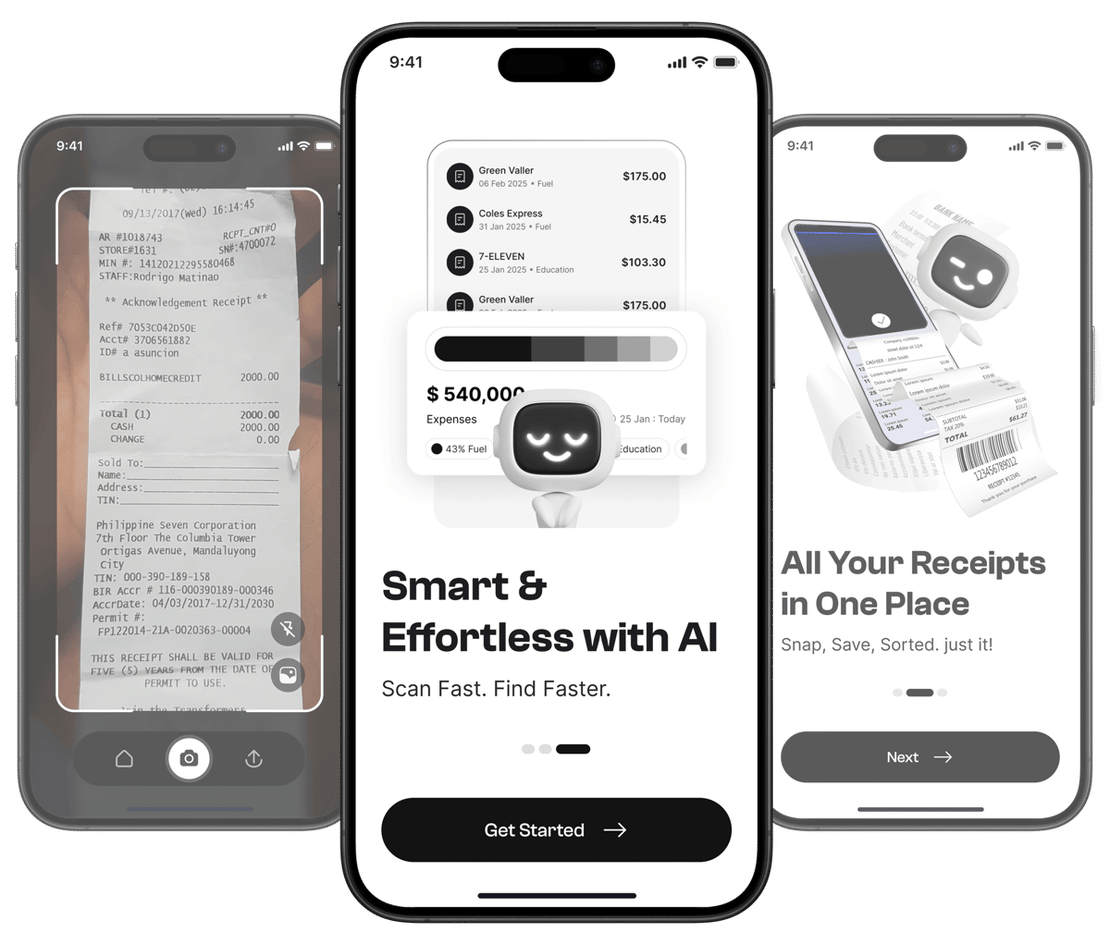
Taxr’s AI categorisation takes this off your plate. When you scan a receipt, the AI analyses the vendor name, amount, and purchase details to suggest the most appropriate category automatically. A receipt from Officeworks gets categorised as “Office Supplies.” A Xero invoice goes under “Software & Subscriptions.” A fuel receipt from BP lands in “Fuel.”
You can review and adjust any suggestion with a single tap, so you stay in control. Over time, the categorisation becomes more accurate as it learns from your spending patterns. The result is consistent, well-organised records without the manual sorting.
For freelancers who track expenses across different types of work – say, a designer who also does consulting – having AI handle the initial categorisation means your records stay organised even when your workload is varied. You can read more about tracking your expenses effectively in our guide on how to track business expenses as a sole trader and our post on ABN expense tracking for Australian freelancers.
Start Categorising Smarter
Getting your expense categories right doesn’t have to be complicated. With Taxr, you scan your receipts, and the AI handles the categorisation for you – accurately, consistently, and aligned with tax requirements. Every receipt is stored securely in the cloud, ready to export when your accountant needs it or when BAS time rolls around. Download Taxr and take the guesswork out of expense tracking.