5 Tax Deduction Tips Every Freelancer Should Know
Table of Contents
In short: The five tips for Australian freelancers are to track every business expense, claim home office costs by the fixed rate or actual cost method, claim work car travel by the cents per kilometre or logbook method, claim professional development that relates to your current work, and keep digital records for five years from the date you lodge. The ATO accepts digital copies as valid records.
As a freelancer in Australia, maximising your tax deductions can make a significant difference to your bottom line. Many freelancers miss out on hundreds or even thousands of dollars in legitimate deductions simply because they don't know what they can claim or don't keep proper records. Here are five essential tips to help you claim everything you're entitled to.
Disclaimer: This article provides general information only and does not constitute tax advice. Consult a registered tax agent for advice specific to your circumstances.
1. Track Every Business Expense
The key to maximising deductions is keeping records of every business-related expense. The ATO requires records for all claims, and without proof, you can't claim the deduction. Common expenses freelancers overlook include:
- Office supplies and equipment (desks, chairs, monitors)
- Software subscriptions (Adobe, Figma, accounting tools)
- Professional development courses and certifications
- Travel expenses for client meetings and site visits
- Bank fees and accounting software costs
The three-test rule
Before claiming anything, the ATO applies three tests to determine whether an expense is deductible. You can only claim an expense if:
- You spent the money yourself and weren't reimbursed
- The expense directly relates to earning your assessable income
- You have a record to prove it
If any of those three fails, the deduction is off the table. A design subscription you forgot to pay for personally (it was reimbursed by a client) fails the first test. A cooking course taken for personal interest fails the second. An eBay purchase you paid for but never kept proof of fails the third.
Worked example
A freelance copywriter earns $78,000 in a financial year. Throughout the year she spends $1,140 on writing software, $420 on an industry conference, $260 on professional membership fees, $180 on reference books, and $95 on postage and stationery. That's $2,095 in legitimate deductions, or roughly $670 back in tax at the 30% marginal rate plus the 2% Medicare levy, which is the bracket her income falls in. Without receipts, none of it is claimable.
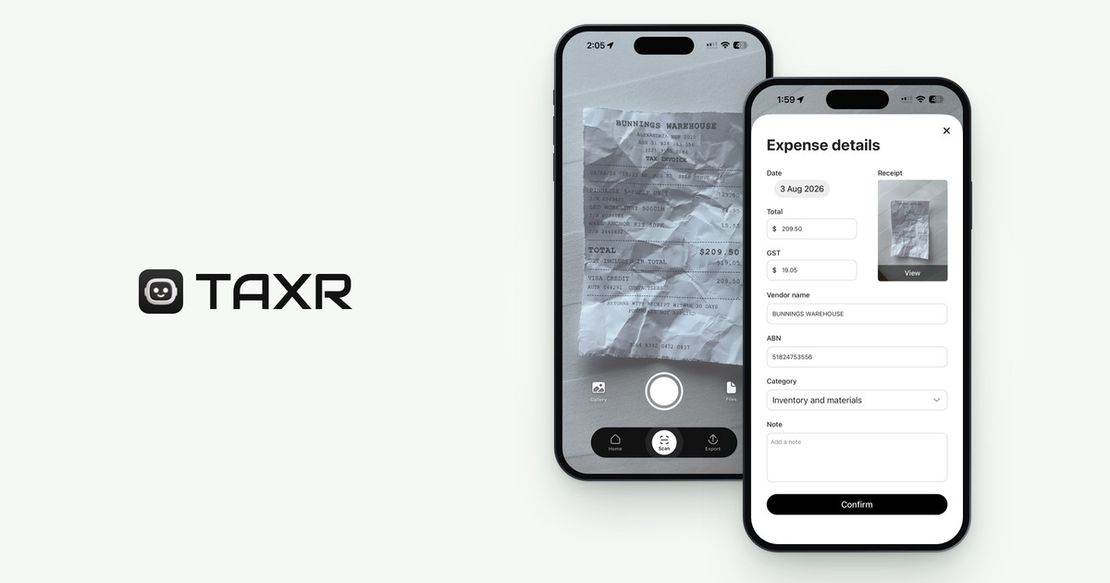
Using an app like Taxr makes this quick: snap a photo of your receipt and the AI extracts the date, amount, vendor name and GST automatically. Every receipt is stored securely in the cloud, categorised and ready for tax time.
2. Claim Your Home Office
If you work from home, you can claim a portion of your rent, electricity, internet, and phone expenses. The ATO allows two methods for calculating your home office deduction:
- Fixed rate method: 70 cents per hour worked from home (the rate for 2024-25 and 2025-26). This covers electricity, internet, phone, stationery, and computer consumables. You still need to separately claim the work-related portion of equipment depreciation.
- Actual cost method: Calculate the actual proportion of expenses used for work. This requires more detailed records but can result in a larger claim if you have a dedicated home office.
Which method should you use?
If you work from a shared space (kitchen table, spare bedroom used for other things), the fixed rate method is usually simpler and perfectly adequate. A freelancer working 25 hours per week from home for 48 weeks logs 1,200 hours, which is $840 in deductions under the fixed rate, with no need to add up individual electricity bills.
The actual cost method tends to produce a bigger number when you have a genuinely dedicated office (a separate room used only for work) and your household bills are substantial. You'll need floor plans, bills, and a reasonable apportionment, typically based on the floor area of your office as a percentage of your home. If your office takes up 10% of your home's floor space and you spend $3,600 a year on electricity and internet combined, you can claim $360 of that. Add the work-related portion of phone, stationery, and depreciation on the equipment inside that office, and the number grows. To compare the two methods for your own hours and costs, try our home office deduction calculator.
The pitfall nobody warns you about
Under the fixed rate method, you cannot double-dip. If you claim 70 cents per hour, you cannot separately claim your internet, phone or electricity: those are already baked into the rate. What you can still claim on top is depreciation of office equipment (laptops, monitors, desks) and the work-related portion of cleaning if you have a dedicated office. Freelancers who aren't aware of this often claim twice and get flagged.
With either method, you need to keep a record of the hours you work from home. A timesheet, calendar or diary entry is sufficient, but the ATO expects a contemporaneous record rather than an estimate you put together the night before lodgement. Taxr can help you track home office equipment purchases and supplies: scan the receipt and file it under "Equipment" or "Office Supplies" for a clean export at tax time.
3. Don't Forget Vehicle Expenses
If you use your car for work purposes (not just commuting to a regular workplace), you can claim vehicle expenses. The ATO offers two methods:
- Cents per kilometre method: 88 cents per km (the 2024-25 and 2025-26 rate; 91 cents for 2026-27) for up to 5,000 business kilometres
- Logbook method: Claim the actual work-use percentage of all running costs
For the logbook method, you need to keep a logbook for at least 12 consecutive weeks to establish your work-use percentage. Claimable costs include fuel, registration, insurance, repairs, servicing, and depreciation.
What counts as a business trip?
Not all driving is claimable, and this is where many freelancers get tripped up. These trips qualify:
- Travel between two separate workplaces on the same day (e.g. your home office to a client site, then to a co-working space)
- Visiting clients, attending meetings, or collecting supplies
- Driving between your main workplace and a temporary workplace (e.g. a short-term project site)
- Carrying bulky tools or equipment that can't be left at work and have no secure storage there
These do not qualify:
- Your normal commute from home to a regular workplace
- Picking up or dropping off mail as a convenience
- Personal errands mixed in with a work trip (you must apportion)
Worked example: cents per km vs logbook
A freelance videographer drives 4,800 work kilometres in a financial year. Under the cents per km method, that's 4,800 x $0.88 = $4,224. No need for a logbook, but she does need to demonstrate how she calculated the kilometres (calendar entries, invoices, or a simple running log). To work out the claim for your own kilometres, use our cents per km calculator.
Alternatively, under the logbook method, suppose her total yearly car expenses are $14,000 (fuel, rego, insurance, servicing, depreciation) and her 12-week logbook shows 40% business use. That's $5,600 in deductions, $1,376 more than cents per km. The trade-off is more detailed record-keeping, both upfront and throughout the year.
A good rule of thumb: if you drive more than about 5,000 business kilometres a year, or have a more expensive vehicle with high running costs, the logbook method usually wins.
Freelancers who drive to client sites, co-working spaces, or between multiple workplaces often underestimate how quickly business kilometres add up. Keep a record of every work-related trip as it happens rather than trying to reconstruct a year's worth of driving in June.
4. Professional Development Counts
Investing in your skills is both smart business and tax-deductible, provided the training relates to your current income-earning activities. The ATO allows claims for:
- Course fees and textbooks related to your current work
- Conference and seminar registration fees
- Professional membership fees (industry associations, unions)
- Industry publications and journal subscriptions
The "current income" distinction
The most important word in the ATO rules on self-education is current. A course must maintain or improve the skills you use in your current work, or be likely to lead to an increase in income from that current work. A graphic designer who takes an advanced Illustrator course is fine. A graphic designer who enrols in a law degree is not: that's training for a new occupation, and the ATO treats those costs as non-deductible capital expenses.
Travel, accommodation, and meals related to attending a professional development course or interstate conference are also claimable, provided the trip is primarily for work. If you tack on a three-day holiday at the end, you can only claim the work-related portion.
Common pitfalls
- Reimbursed courses: If a client or agency paid for your training, you cannot claim it. You can only deduct what you personally paid out of pocket.
- Informal learning: YouTube courses, free tutorials, and unpaid study don't count unless you paid for them. The deduction is always tied to the dollar amount spent.
- HECS/HELP repayments: These are not deductible, even if the degree relates directly to your work.
Keep the receipts and invoices for all professional development expenses. With Taxr, you can scan course invoices and conference receipts as they come in, so nothing slips through the cracks when you lodge your return.
5. Keep Digital Records
The ATO requires you to keep records for five years from the date you lodge your tax return. Paper receipts fade, get lost, and take up space. Going digital solves all of these problems. Also worth noting for 2026-27: the Budget introduced a $1,000 instant tax deduction for the work-related expenses of people with wage or salary income. It doesn't apply if your only income is from freelancing as a sole trader, so it matters mainly if you also have a job.
- No lost or faded paper receipts
- Easy search and retrieval when you need a specific expense
- Automatic categorisation into ATO-aligned tax categories
- Ready-to-export reports your accountant can work with immediately
The ATO accepts digital copies of receipts as valid records, so there's no reason to keep paper originals once you've digitised them.
Frequently Asked Questions
What can freelancers claim as tax deductions in Australia?
Australian freelancers can claim expenses that are directly related to earning their income. Common deductions include home office costs (70 cents per hour fixed rate or actual costs), vehicle expenses (88 cents per km for 2025-26, 91 cents for 2026-27, or the logbook method), equipment and software, professional development, phone and internet, insurance premiums, and bank fees. All claims must be supported by records kept for five years.
How long do I need to keep tax receipts in Australia?
The ATO requires you to keep records for five years from the date you lodge your tax return. Digital copies are accepted as valid records, so you don't need to keep paper originals once you've scanned them. Using an app like Taxr ensures your receipts are stored securely in the cloud and won't fade or get lost.
Can I claim working from home expenses as a freelancer?
Yes. If you work from home, you can claim using the fixed rate method (70 cents per hour, covering electricity, internet, phone, stationery, and computer consumables) or the actual cost method (calculating the real proportion of expenses used for work). Both methods require you to keep a record of the hours you work from home.
Do I need receipts for every tax deduction I claim?
Yes. The ATO requires documentary evidence for all deduction claims. For expenses of $10 or less, you may not need a receipt if obtaining one is not practical, provided you make your own written record of the details as soon as possible after the expense and these small expenses total $200 or less for the year, but for all other claims you need a receipt or invoice: a bank or credit card statement on its own isn't enough.
Start Tracking Today
The best time to start tracking your expenses is now. Don't wait until June to scramble through shoeboxes of receipts. With Taxr, you can scan receipts in seconds, get a category suggested for each one, and export a clean report for your accountant when tax time arrives. Download Taxr and never miss a deduction again.