What the 2026 Budget Means for Rideshare Drivers
Table of Contents
If you drive Uber, Didi, Ola, Bolt, or any other rideshare platform, here’s what the 12 May 2026 federal budget 2026 rideshare changes actually mean for your tax bill. Most of the budget coverage focuses on cost-of-living relief and housing — but three specific measures hit rideshare drivers directly, and two of them could cost you money if you get them wrong. Here’s the plain-English rundown.
For a full picture of what you can already claim, start with our complete guide to tax deductions for rideshare drivers in Australia.
Disclaimer: This article provides general information only and does not constitute tax advice. Consult a registered tax agent for advice specific to your circumstances.
The Three Changes That Matter Most for Rideshare Drivers
Three measures from the 2026-27 Budget land squarely on rideshare drivers. First, the $20,000 instant asset write-off (IAWO) is now permanent — good news if you spend money on in-car gear. Second, a new optional $1,000 flat work-related deduction replaces itemising for some workers — but almost certainly not for you. Third, the ATO received $75.7 million in additional compliance funding over four years, with rideshare and sharing-economy income explicitly in scope. Each of these is unpacked below.
Permanent IAWO — In-Car Gear Under $20k
The instant asset write-off threshold of $20,000 has been made permanent from 1 July 2026, removing the annual uncertainty that had plagued small business planning for years (Budget Paper No. 2, 2026-27). For rideshare drivers who operate as sole traders — which is most of you — this means any individual asset used in your driving that costs less than $20,000 can be written off in full in the year you buy it, rather than depreciated over several years.
What does that look like in practice? Think dash cams, phone holders, in-car charging stations, GPS units, premium floor mats, a portable vacuum for keeping the cabin spotless, or a car-mounted tablet. If you’ve been eyeing a $400 dash cam or a $250 wireless charging pad to wire into your centre console, FY2026-27 is the time to buy it — the full cost comes straight off your taxable income in one hit.
The important caveat: the car itself almost certainly doesn’t qualify. New vehicles easily exceed $20,000, and even a second-hand car used for rideshare will often tip over the threshold. The car is also subject to the luxury car cost limit, which caps the depreciable value regardless of what you paid. The IAWO benefit for rideshare drivers sits firmly in the accessories and equipment category, not the vehicle itself. For more detail on how the permanent IAWO works and who qualifies, see our post on the permanent instant asset write-off from the 2026 Budget.
The strategic move here is timing. If you’ve been putting off upgrading your in-car tech setup, do it in FY2026-27 and keep the receipts. One purchase on 1 July and you’re claiming the full amount at tax time.
$1,000 Flat Deduction — Almost Always a Lose for Rideshare
One of the headline announcements from the 2026-27 Budget was a new optional $1,000 flat work-related expense deduction. The idea is simple: instead of gathering and itemising every receipt for work-related costs, you can claim $1,000 without any substantiation at all. For someone with minimal deductions — say, an employee who occasionally works from home — this is genuinely useful.
For an active rideshare driver, it is almost certainly a trap.
Run the numbers. The cents-per-km rate for FY2025-26 is 88 cents per business kilometre, capped at 5,000 km. A driver doing a modest 200 km per week for ridesharing puts on roughly 10,400 rideshare kilometres across a year. Apply the 5,000 km cap and the 88-cent rate, and you’re already at $4,400 in vehicle deductions before you’ve claimed a single other expense. Even if your actual rideshare kilometres are lower — say 120 km per week, 50% of which is business — you’re still looking at 3,120 km, which is $2,746 just from the cents-per-km method.
Now add the rest: the work-related portion of your phone plan, the platform service fees Uber or Didi deducts from your earnings, car cleaning (a $20 wash every two weeks is $520 per year), passenger water and snacks, and any in-car gear you depreciate. The $1,000 flat deduction is gone before you even touch vehicle costs.
The one scenario where you might consider the flat deduction: you drive only a handful of trips per month, your business kilometres are genuinely minimal, and your other expenses are small. Even then, it’s worth doing the maths before defaulting to it. Our post on flat $1,000 vs itemising — which deduction wins? has a worked decision framework you can run through in a few minutes.
The practical rule for rideshare drivers: itemise. Always.
ATO Data-Matching Crackdown
This is the one that catches drivers off guard. The ATO’s Sharing Economy Reporting Regime requires platforms — Uber, Didi, Ola, Bolt, and others — to report driver earnings directly to the ATO. This has been in place for ride-sourcing platforms since 2023, and the ATO cross-references that data against what you lodge on your tax return.
The 2026-27 Budget added $75.7 million in ATO compliance funding over four years, specifically targeting personal income tax compliance. Rideshare and gig-economy workers are explicitly named in the compliance focus areas. What this means in plain terms: if your platform paid you $38,000 last year and you declared $32,000, the ATO already knows the discrepancy before you even lodge.
Do not try to hide platform income. It’s pre-filled in your myGov account from the platform’s reporting. Adjusting it downward without a legitimate reason — such as a GST adjustment or a genuine error in the platform’s figures — is an audit trigger, not a shortcut.
The more common (and more forgivable) mistake is drivers not reconciling platform earnings against their bank deposits. Platforms pay weekly or fortnightly, and the net amount hitting your account already has service fees deducted. Your gross earnings — what the platform reports to the ATO — are higher than your bank deposits. Make sure your declared income matches the gross figure on your annual tax summary from the platform, not your bank statements.
For a full breakdown of the ATO’s enforcement expansion, see our post on the ATO shadow economy crackdown from the 2026 Budget.
Vehicle Deductions Still Cents-Per-KM or Log Book
Nothing in the 2026-27 Budget changes your two options for claiming vehicle expenses, and the cents-per-km rate remains at 88 cents for FY2025-26. Here’s how the two methods sit side by side:
Cents-per-km method: Multiply your business kilometres by 88 cents. No receipts required — you just need to be able to explain how you calculated the distance. Capped at 5,000 business kilometres per year, so the maximum claim is $4,400. Simple, but capped.
Log book method: Keep a 12-week log of every trip — both rideshare and personal. This establishes your business-use percentage. Apply that percentage to all actual running costs for the full year: fuel, registration, insurance, servicing, tyres, car loan interest, and depreciation. No cap on kilometres. A valid log book runs for five years if your driving pattern stays reasonably consistent.
For most drivers doing rideshare regularly, the log book method delivers a substantially larger deduction. A driver putting 30,000 km on the car annually with 70% business use can claim 70% of all running costs — often $8,000 to $12,000 or more depending on the vehicle — versus a maximum of $4,400 under cents-per-km.
If you haven’t kept a log book before, starting mid-year is still better than not starting at all. A partial log book isn’t ATO-compliant for the current year, but it positions you well to establish your percentage from 1 July for FY2026-27. Use our cents-per-km calculator to see how the methods compare for your situation.
For the full ATO breakdown on vehicle and travel expense deductions, see our vehicle travel expense deductions guide.
What Hasn’t Changed
It’s worth naming what the Budget left alone, because there’s a lot of noise in the financial press right now:
- GST registration for rideshare: You must register for GST regardless of your turnover. Rideshare driving is classified as taxi travel under the GST Act, and the $75,000 threshold that applies to other businesses does not apply to you. This has not changed and is not changing.
- Cents-per-km rate: Still 88 cents per business kilometre for FY2025-26. No change proposed.
- WFH rate (67 cents per hour): Irrelevant to most rideshare drivers — you’re working from a vehicle, not a home office.
- The log book rules: Unchanged. Still 12 consecutive weeks, valid for five years, same business-percentage calculation.
Action List for Rideshare Drivers This Week
- Log every in-car gear purchase under $20,000. Dash cam, phone holder, charging pad — from 1 July 2026, the full cost is deductible in the year of purchase under the permanent IAWO. Keep the receipts.
- Confirm your platform earnings in myGov. Log into myGov and check what your platform has pre-filled as your income. If the figure looks wrong, contact the platform’s driver support before lodging — not after.
- Start a log book if you haven’t got one. Even mid-year. Set up a simple spreadsheet or use the ATO’s myDeductions app for now. You’ll need 12 consecutive weeks to establish your business-use percentage for FY2026-27.
- Reconcile platform earnings against bank deposits monthly. Your gross income (what the ATO sees) is higher than your net deposits. Make sure you’re declaring the right number.
- Itemise your deductions — do not take the flat $1,000. Run the numbers for your situation using our calculator, but for active drivers the answer is almost always to itemise.
- Check the for gig workers page for tools and guides specific to your working situation.
Frequently Asked Questions
Does the permanent IAWO help rideshare drivers?
Yes — for assets under $20,000 used in your driving: dash cam, phone holder, in-car charging upgrade, GPS device, floor mats, portable vacuum. The car itself usually exceeds the $20,000 threshold and depreciates under standard rules subject to the car cost limit, so the IAWO benefit is in your accessories and equipment, not the vehicle.
Should rideshare drivers take the $1,000 flat deduction?
Most won’t benefit from it. Vehicle expenses alone — cents-per-km multiplied by your business kilometres — typically exceed $1,000 well before you add phone costs, platform fees, cleaning, or passenger supplies. Run the numbers first, but for any active driver, itemising almost always wins.
Does the ATO know my rideshare income?
Yes. Major rideshare platforms report driver earnings directly to the ATO under the Sharing Economy Reporting Regime. The 2026-27 Budget allocated an additional $75.7 million for ATO personal income tax compliance over four years, with rideshare and gig-economy drivers explicitly in scope. Your gross earnings appear as a pre-fill in your myGov account before you even start your return.
Is the cents-per-km rate changing?
No. The cents-per-km rate remains at 88 cents per business kilometre (FY2025-26 rate) for up to 5,000 business kilometres. The Budget did not propose any changes to vehicle expense deduction rates or methods.
Should I keep a log book?
If you drive more than 5,000 kilometres for ridesharing in a year — which most regular drivers do — the log book method will almost certainly deliver a larger deduction than the capped cents-per-km method. The log book is valid for five years if your driving pattern stays broadly consistent. Start one now even if you’re mid-year; it positions you for a full year’s claim from 1 July.
What happens if I don’t declare rideshare income?
ATO data-matching from platform reporting will identify the discrepancy. Penalties for under-reporting range from 25% to 75% of the shortfall tax, depending on whether the ATO considers the omission a mistake, recklessness, or deliberate evasion. Voluntary disclosure before an audit commences reduces penalties significantly — contact the ATO or a registered tax agent if you have prior years to correct.
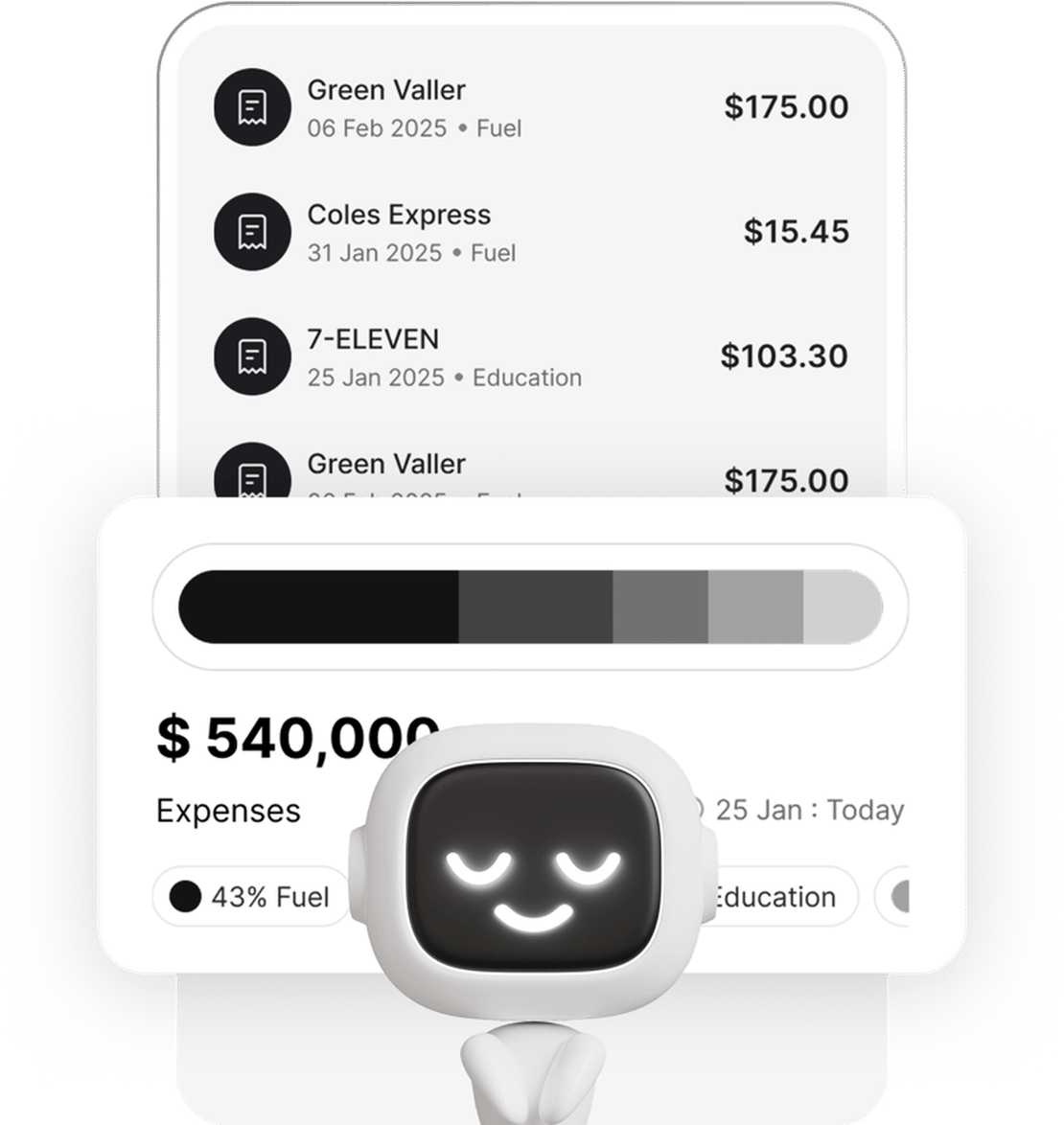
Rideshare drivers lose more deductions to forgotten receipts than to anything else in the tax system. Every car wash, every petrol fill, every bag of mints for your passengers — those are real deductions that disappear the moment the receipt does. Taxr’s AI scanner captures them in seconds: point your phone at the receipt, and the date, amount, vendor, and GST are logged automatically. No shoebox. No spreadsheet. No stress at tax time. Download Taxr and stop leaving money on the road.