1099-NEC vs. 1099-K: Which Tax Form Will You Actually Get?
Table of Contents
In short: For 2026 payments, a client who pays you $2,000 or more for services in the course of their business must send you and the IRS a Form 1099-NEC. A payment platform or marketplace sends a Form 1099-K only for more than $20,000 in gross payments and more than 200 transactions in a year. Most casual sellers won't get one, but the income is still taxable.
If you picked up freelance work, drove for a delivery app, or sold anything online in 2026, tax season is going to hand you a form or, increasingly, no form at all. The two that cause the most confusion are the 1099-NEC and the 1099-K. They look similar, they both report money that landed in your account, and they both eventually feed into the same Schedule C. But they come from different senders, trigger at very different thresholds, and understanding which one applies to you (and which one won't show up) matters more this year than it has in a while.
Disclaimer: This article provides general information only and does not constitute tax advice. Consult a tax professional, such as a CPA or enrolled agent, about your circumstances.
Form 1099-NEC: Payment From a Client, Directly
Form 1099-NEC ("Non-Employee Compensation") is issued by a business or individual who paid you directly for services. If a client, agency or company paid you $2,000 or more in 2026 for work you did as an independent contractor, in the course of their business, they're required to send you a 1099-NEC by January 31, and to send an identical copy to the IRS.
This is the classic freelance-income form. A web developer invoicing a startup $8,000 for a project gets one. A marketing consultant on a $400/month retainer gets one once the year's payments cross $2,000. A handyman who did one $2,500 job for a property management company gets one too, even though it was a single job, not an ongoing relationship. (A homeowner paying for work on their own home doesn't have to send one: only payments made in the course of a trade or business are reportable.)
The threshold used to be $600. The One Big Beautiful Bill Act raised it to $2,000 for payments made after December 31, 2025, with inflation adjustments possible from 2027, and the IRS instructions for the 2026 forms confirm it. So a client who paid you $1,500 in 2026 doesn't have to send a form. Keep tracking everything regardless of the dollar amount, since the reporting threshold for the payer has never determined what you owe.
Form 1099-K: Payment Through a Platform
Form 1099-K is different in almost every respect. It's issued by third-party payment platforms and marketplaces (think Etsy, eBay, eBay-style resale apps, Airbnb, DoorDash, Uber, or a business PayPal/Venmo account), and it reports the gross payment volume that moved through the platform on your behalf, not your profit.
For 2026, the 1099-K threshold is more than $20,000 in gross payments AND more than 200 transactions in a calendar year. Both conditions have to be met: a platform doesn't send you a 1099-K just because you crossed $20,000 with three large transactions, and it doesn't send one because you had 300 tiny transactions that added up to $3,000. This is a reversion: a much lower threshold had been scheduled to phase in over the past few years, but the One Big Beautiful Bill Act (OBBBA) rolled it back to the original $20,000-and-200-transaction rule. As a result, the IRS cut its projection of how many Forms 1099-K will be filed in 2026 by about 20 million, to roughly 13.3 million (IRS Publication 6961, September 2025).
Side by Side
| Form 1099-NEC | Form 1099-K | |
|---|---|---|
| Who sends it | A client or business that paid you directly | A payment platform or marketplace |
| Threshold | $2,000 from a single payer (2026 payments) | Over $20,000 AND over 200 transactions |
| What it reports | Payments for services | Gross payment volume processed |
| Typical recipient | Freelancers, consultants, contractors | Platform sellers, some gig drivers |
| Deadline to receive | January 31 | January 31 |
The Practical Consequence: No Form Doesn't Mean No Tax
This is the part that trips people up. Because the 1099-K threshold sits at $20,000 and 200 transactions, the overwhelming majority of casual sellers, part-time gig workers, and people clearing out a closet on a resale app will not receive a 1099-K for their 2026 activity. If you sold $6,000 of handmade goods on Etsy this year across 90 orders, no form is coming.
That does not make the income tax-free. All income is taxable whether or not a form gets issued for it. The 1099-K was never the thing that created the tax obligation, only a way of reporting it. In years when the threshold sat lower, more casual income got automatically documented by the platform, which functioned as a kind of unintentional record-keeping backstop. With the threshold back up at $20,000, that backstop is gone for most people. Nobody is tracking that income for you anymore. The reporting gap didn't close; it just moved the responsibility entirely onto you.
What to Do When Each Form Shows Up
If you get a 1099-NEC:
- Match it against your own invoices and payment records before you file anything.
- Report the amount as gross receipts on Schedule C.
- If the number is wrong or you never got the form at all, contact the payer for a correction. Don't wait until April to sort it out, and don't skip reporting income just because a form never arrived.
If you get a 1099-K:
- Remember the number is gross payment volume, not profit. It can include refunds, sales tax the platform collected, or shipping charges you passed through, depending on the platform.
- Reconcile the total against your actual records and back out anything that isn't real business income (a personal reimbursement that accidentally ran through a business PayPal account, for example).
- Report the legitimate business portion on Schedule C, and keep your reconciliation notes in case a number is ever questioned.
Income With No Form at All
Whether or not any 1099 lands in your inbox, you're required to report all self-employment income. Schedule C asks for your total gross receipts, not "gross receipts backed by a form." The freelancers who get this wrong aren't usually trying to hide anything; they just assume no form means no obligation. It doesn't. Good records (invoices, bank deposits and the receipts for the expenses that offset that income) are what let you file accurately whether a form shows up or not. Our guide to 1099 expense tracking walks through what a solid year-round system looks like.
Getting the Rest of the Picture Right
Whichever form you get, or don't, the income still needs to be estimated and paid throughout the year, not just reported at filing time. See our breakdown of the quarterly estimated tax dates for the 2026 tax year, and if you want help running the numbers, our free 1099 tax calculator estimates your self-employment tax and quarterly payments in a couple of minutes. For a full line-by-line walkthrough of where this all lands on your return, see our Schedule C expense category guide.
Where Taxr Fits In
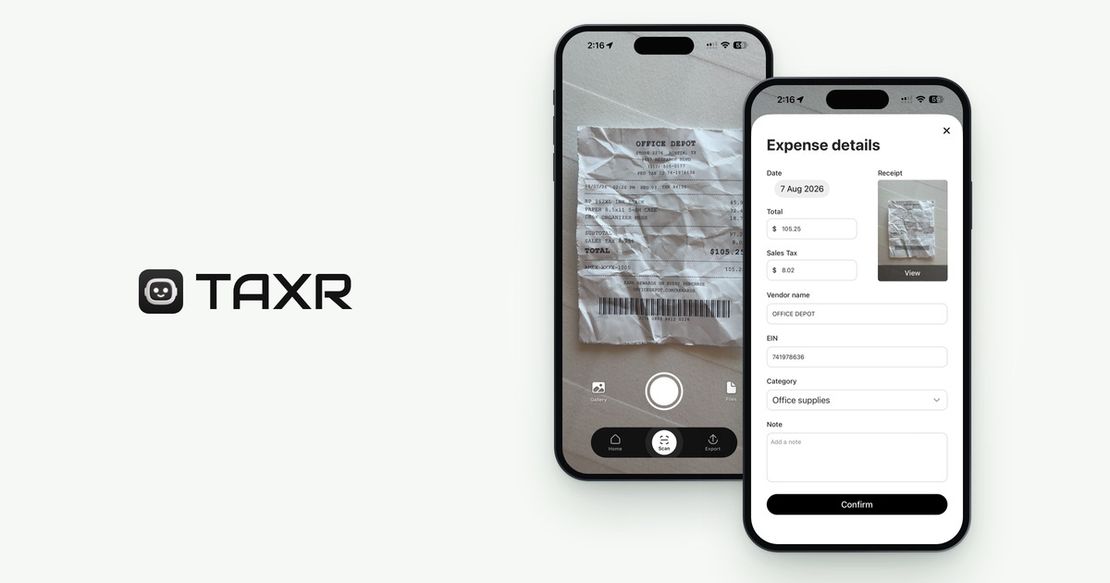
Taxr doesn't file your 1099s or replace your tax software. It handles the other half of the equation: the expenses that offset whatever income lands on your 1099-NEC, your 1099-K, or no form at all. Scan a receipt and Taxr's AI reads the vendor, date and amount, then suggests a Schedule C-aligned category for you to confirm. At filing time, export a clean, categorized Excel or PDF report to work from in your tax software, or email it to your CPA: no shoebox, no spreadsheet archaeology, no guessing what a charge from eight months ago was for.
Whether your income this year comes with a form attached or not, the expense side of your return is only as strong as the records behind it. Download Taxr free and start building that record now, before the forms (or the absence of them) show up in January.